The Most Expensive Website Isn't the One That Costs the Most
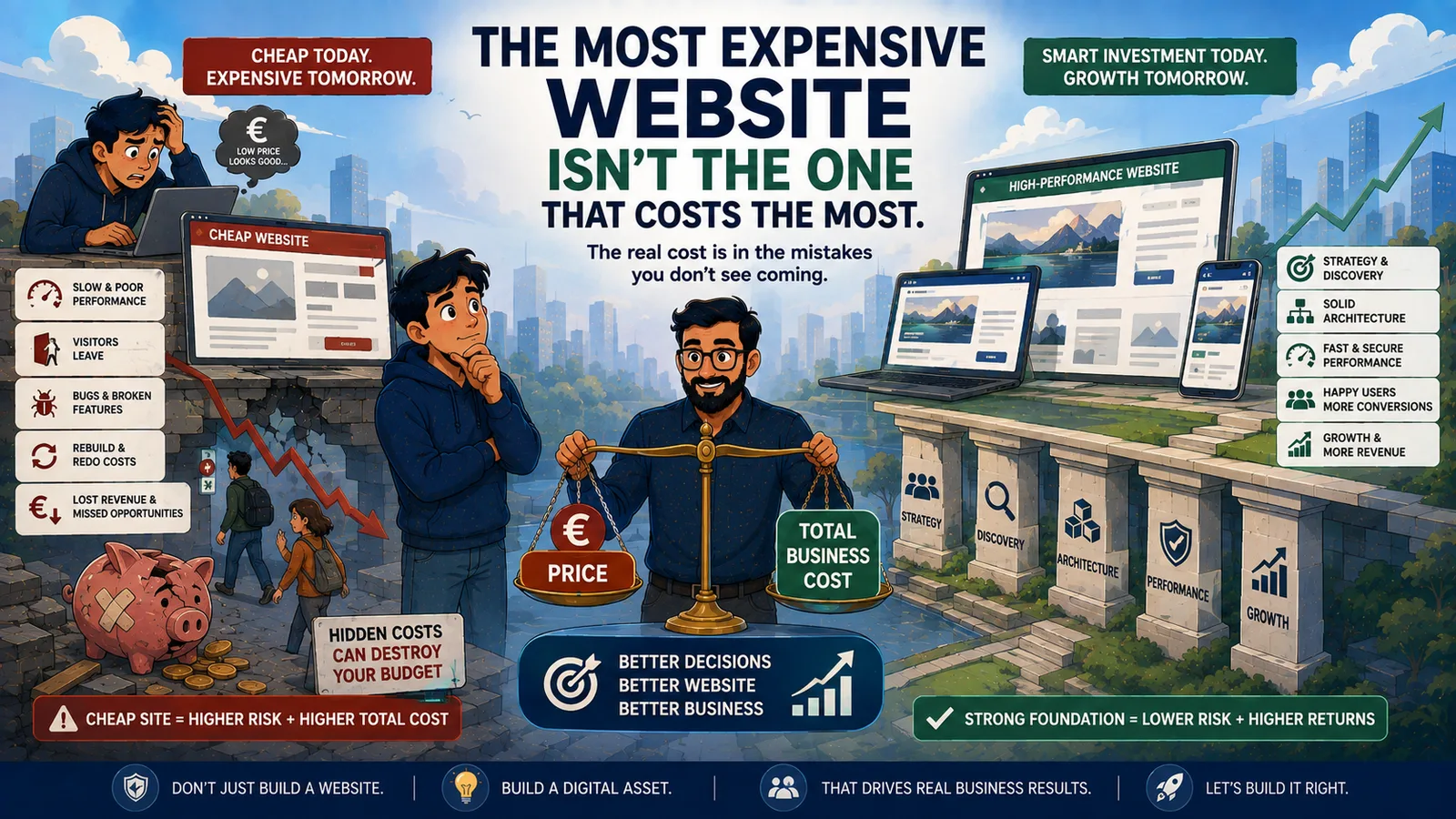
Whenever businesses make an important investment, one of the first things they compare is price. It’s a natural instinct. The same happens when purchasing new equipment, choosing a new office, selecting a software vendor, or hiring a company to build a new website.
Digital projects, however, are different. The cost of development represents only a small portion of the total cost that the project will generate over its lifetime.
A website may cost €5,000. Or €50,000. Yet its impact on a business can represent tens of thousands, hundreds of thousands — or even millions of euros in additional revenue or missed opportunities.
Not because a website generates revenue on its own, but because it influences almost every stage of the customer journey: how people discover a company, whether they stay on the website, whether they find the information they’re looking for, whether they trust the brand, and ultimately, whether they decide to make a purchase or get in touch.
That’s why the most expensive mistakes in a digital project rarely happen during development. They happen long before the first line of code is ever written.
The hidden cost of poor decisions
When companies talk about the cost of a website, they usually think about the invoice they receive from the development team. In reality, that’s only the visible cost.
There is another cost that is much harder to measure: the cost of missed opportunities.
A slow website isn’t just a frustrating experience for visitors. It can mean users leaving before they even see your offer, contact forms that are never submitted, bookings that never happen, and sales inquiries that end up with your competitors instead.
According to Google, 53% of mobile users abandon a website if it takes longer than three seconds to load. In addition, research published by Akamai has shown that even an additional 100 milliseconds of latency can reduce conversion rates by approximately 7%.
These statistics don’t suggest that every slow website loses exactly the same percentage of customers. What they do demonstrate is something much more important: technical performance has a measurable impact on user behavior — and user behavior directly influences business performance.
That’s one of the reasons why large organizations invest heavily in architecture, performance engineering, and user experience. Not because they want better scores in testing tools, but because every second saved can lead to more customers, higher engagement, and increased revenue.
A simple example
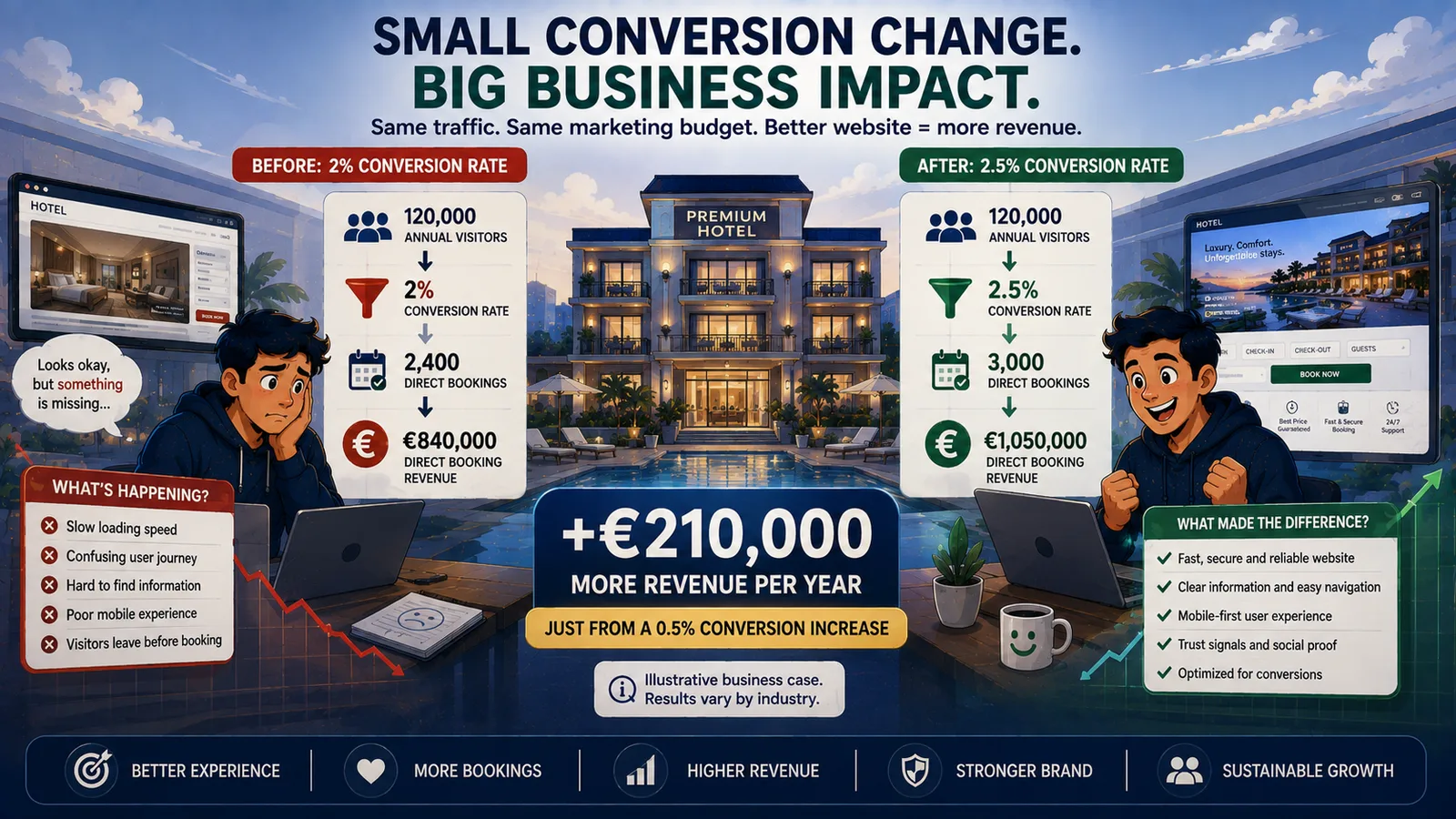
Imagine a hotel that receives 120,000 visitors per year through its website. If its booking conversion rate is 2%, and the average reservation value is €350, the result is:
- 2,400 bookings per year
- €840,000 in direct booking revenue
Now imagine that, after investing in proper discovery, technical architecture, user experience improvements, and performance optimization, the conversion rate increases from 2% to 2.5%. Website traffic remains exactly the same. The marketing budget doesn’t change. The only difference is the quality of the digital platform. The result becomes:
- 3,000 bookings per year
- €1,050,000 in direct booking revenue
That’s an additional €210,000 in annual revenue, generated without increasing advertising spend or attracting more visitors.
This is a simplified example — not a guarantee of results. In reality, business outcomes depend on many factors, including competition, market conditions, traffic quality, pricing strategy, and customer behavior. However, it clearly illustrates why improving a digital platform can generate significantly greater business value than its initial development cost.
Why large organizations spend months on discovery and consulting
Perhaps the least visible part of any digital project is also one of the most valuable. Large organizations rarely begin by choosing colors or technologies. They begin by asking questions:
- What is the platform expected to achieve?
- How does the business generate revenue?
- Where do qualified visitors come from?
- Where do users leave the customer journey?
- Which business systems need to be integrated?
- What should the company look like three — or even five — years from now?
The answers to these questions shape the architecture of the entire platform. And architecture influences performance, scalability, security, maintenance costs, and the platform’s ability to evolve over time.
For that reason, technical consulting is not an administrative step. It is one of the most valuable investments in any digital project.
The most expensive mistakes don’t happen during development. They happen before the first line of code.
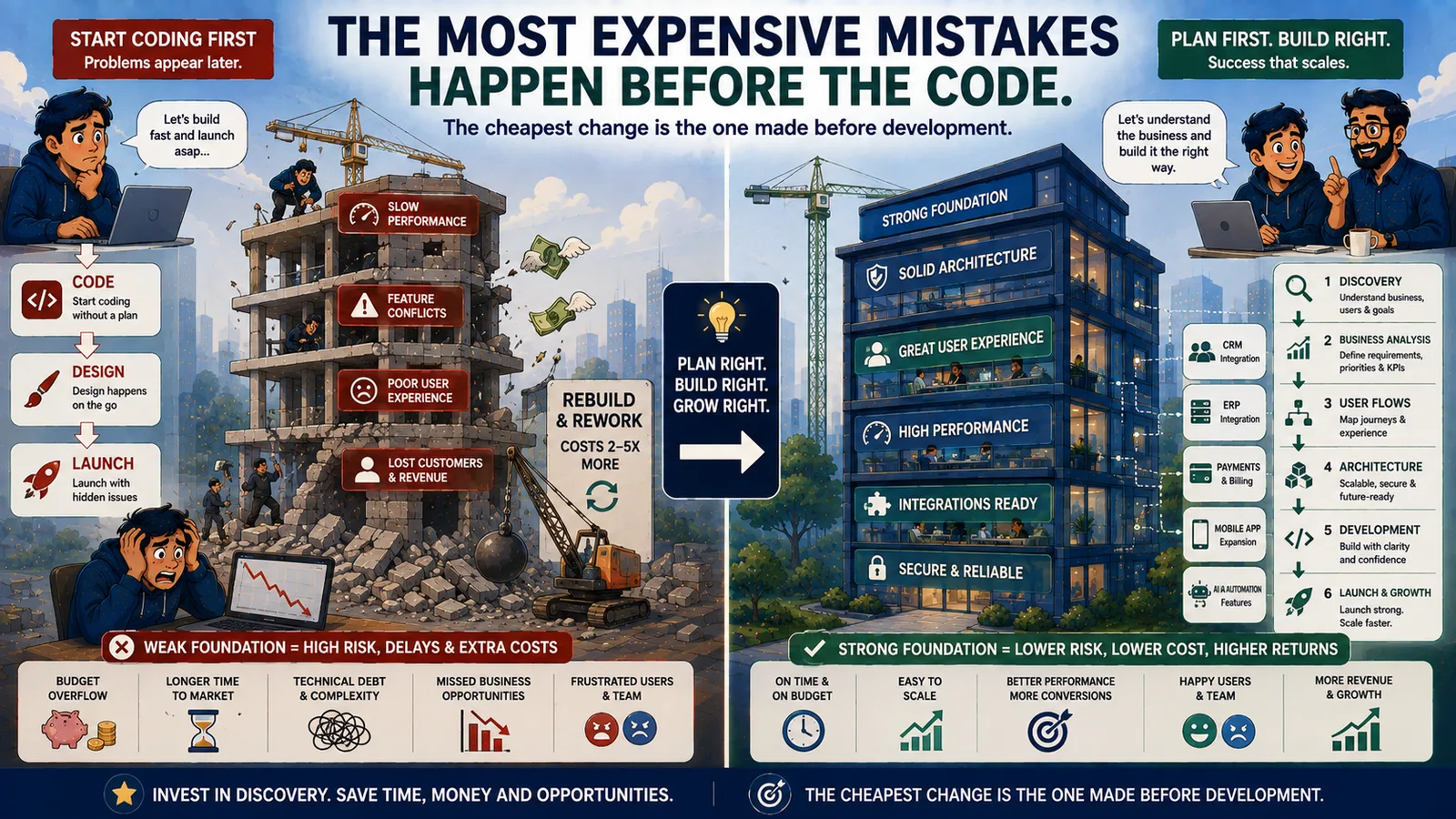
Many business owners believe that building a website starts when the first design appears or when developers begin writing code. In reality, the projects that create the most problems are the ones that start too soon: without an analysis phase, without clear objectives, without an understanding of how the company attracts customers and generates revenue.
In those situations, the team builds exactly what it was asked to build — not necessarily what the business actually needed. That is one of the most expensive differences in software development.
Consulting isn’t about meetings. It’s about reducing risk.
In large companies, the consulting phase can last weeks or even months. Not because development is complicated, but because changing a decision after launch is almost always more expensive than making the right decision from the start.
At this stage, questions such as these are analyzed:
- Who are the platform’s users?
- What is the website’s primary objective?
- How do customers reach the site?
- Where do they abandon the process?
- Which systems need to be integrated?
- How will the company evolve over the next 3–5 years?
At first glance, these questions don’t seem related to building a website. In reality, they influence nearly every technical decision that follows.
A simple example: the same investment, completely different results
Suppose two companies each invest €20,000 in a new website.
The first starts development immediately. It picks a design, receives the pages, and launches the project. Six months later, it discovers that:
- users can’t find the important information;
- the main form generates few inquiries;
- the CRM integration was never planned;
- mobile performance falls short of expectations;
- certain features have to be rebuilt.
Over the following 18 months, the company invests another €15,000–20,000 in changes and additional development.
The second company spends a few weeks on the analysis phase. Before development begins, the objectives, architecture, system integrations, and growth plan are all defined. The website it launches isn’t just functional today — it’s ready for the years ahead.
The initial budget may be very similar. The total cost of the project, however, can end up completely different. Not because one team writes code faster, but because one of them reduced the risk before development even began.
A high-performing website doesn’t just cut costs. It can grow revenue.
Conversations about web development often focus on cost. In reality, the more important question is a different one: how much is a new customer worth to the company?
Take a simplified example. A B2B company receives roughly 50,000 visitors per year on its website. Its current conversion rate is 2%, which means about 1,000 sales inquiries.
If, after improving user experience, speed, and site structure, the conversion rate rises to 2.5%, the company reaches 1,250 inquiries. That’s 250 additional commercial opportunities, without increasing the marketing budget.
If only 10% of those opportunities become customers, and the average contract value is €15,000, the result is: 25 new customers × €15,000 = €375,000 in potential additional annual revenue.
This is a hypothetical scenario, not a guarantee of results. In practice, performance depends on industry, competition, traffic quality, and the sales process. But the example shows why many companies view their website as an asset that can influence revenue — not merely as a development cost.
Performance is a measurable competitive advantage
In recent years, website performance has become increasingly well documented. Among the most frequently cited findings:
- 53% of mobile users abandon a website that takes longer than three seconds to load, according to Google.
- BBC reported that it loses about 10% of its users for every additional second of page load time.
- Amazon estimated that a delay of just 100 ms can reduce sales by about 1% — which is why large companies invest constantly in performance optimization.
These numbers don’t mean that any fast website will automatically generate more sales. But they show something important: for organizations that depend on their online presence, technical performance isn’t just a developer’s concern. It’s a component of business strategy.
How to recognize the right technology partner before you sign the contract
Most companies evaluate technology partners in almost exactly the same way: price, delivery time, portfolio, technologies used. All of these factors matter — but surprisingly, they reveal very little about whether a project will actually succeed.
There is a far better indicator: the team’s process. How a technology partner approaches a project often tells you much more than the technologies listed on its website.
Great technology partners start by understanding the business
If your first meeting lasts thirty minutes and ends with a price quote, the conversation was probably too short.
The first questions shouldn’t be “How many pages do you need?”, “Which colors do you prefer?” or “Which platform would you like to use?”. The first conversation should focus on the business itself:
- How do customers discover your company?
- What are your primary revenue streams?
- What problems are your customers trying to solve?
- What are your business objectives over the next three years?
- Which processes could be automated?
- How is your company expected to grow?
The website is simply a tool. The business should always be the starting point.
Experience isn’t measured only in years
One of the biggest misconceptions in the technology industry is that experience can be measured simply by the number of years someone has worked. Years certainly matter, but they tell only part of the story. What matters even more is the type of projects a team has delivered.
One developer may have fifteen years of experience building relatively simple websites. Another may have spent seven years designing enterprise infrastructure used by millions of people every day. Who has the more valuable experience? The better questions are:
- What types of systems has this team built?
- How complex were those projects?
- Which industries have they worked with?
- Did they design the architecture, or simply implement predefined specifications?
- Have they built platforms that continued evolving over many years?
True experience is measured by the ability to make better technical decisions before problems appear.
Portfolios show what was built. Questions reveal how teams think.
A portfolio can certainly be impressive — beautiful interfaces, recognizable brands, modern technologies. But a portfolio only shows the final result. It rarely explains how that result was achieved.
An experienced technology partner should be able to explain why a particular architecture was recommended, why certain technologies were deliberately avoided, which trade-offs were considered, and how the platform can evolve over time. And perhaps most importantly, they should be willing to tell a client when an idea is not the right solution — even if implementing it would increase the project’s value. That is often one of the clearest signs of a long-term technology partner: they optimize for the client’s success, not for the size of the invoice.
Ask what the platform will look like five years from now
Very few business owners ask this question, yet it may be the most important one. A website shouldn’t be designed only for launch day. It should be designed for the next stage of the company’s growth.
Today, your business may only require a corporate website. Two years from now, you may need:
- CRM integration;
- online payments;
- a mobile application;
- AI-powered automation;
- a customer portal;
- ERP integration;
- multilingual support.
If the original architecture wasn’t designed with those future requirements in mind, every new feature becomes more expensive to implement. In some cases, companies discover that expanding the platform costs almost as much as rebuilding it from scratch. That’s why experienced technology teams don’t simply design for today’s requirements. They build platforms that are ready for tomorrow’s opportunities.
Why large organizations invest so much in consulting before development begins
If you were to walk into the offices of companies like Microsoft, Amazon, Booking.com, Airbnb, or Spotify on the first day of a new digital project, you might be surprised by what you see. You probably wouldn’t find developers writing code. You wouldn’t see designers creating polished interfaces. And, in many cases, you wouldn’t even see a prototype.
Instead, you would see people talking, analyzing, asking questions, mapping user journeys on whiteboards, reviewing data, and speaking with sales, marketing, customer support, and executive teams.
Why? Because organizations that build digital products at scale have learned one fundamental lesson: the least expensive change is the one made before development begins.
A decision made too late can cost many times more
Imagine two different scenarios. In the first, the project team discovers during the discovery phase that, within the next two years, the platform will need to integrate with both an ERP system and a CRM. Because this requirement is identified before development starts, the platform’s architecture is designed with those future integrations in mind. The additional cost is minimal.
Now imagine the same requirement is discovered after the platform has already been launched. The situation changes completely: the architecture needs to be modified, the database structure must be updated, parts of the application have to be rewritten, existing functionality must be tested again, and in some cases even elements of the user interface and user experience need to be redesigned.
The problem isn’t that the integration can’t be done. The problem is that the exact same decision becomes significantly more expensive simply because it was made too late. That’s one of the primary reasons why the Discovery phase is considered one of the most valuable investments in any software project.
Consulting doesn’t slow a project down. It prevents costly mistakes.
Some businesses believe that spending time on analysis delays development. In practice, the opposite is often true.
A single week invested in understanding the business can save months of changes after launch. A workshop lasting only a few hours can eliminate features that users would never need. A conversation with the sales team can completely change how products or services should be presented online. User interviews can uncover problems the organization didn’t even know existed.
This is why the best digital projects don’t begin with development. They begin with the right questions.
A website is only one part of a digital ecosystem
One of the biggest changes over the past decade is that websites no longer operate in isolation. Today, a digital platform is connected to numerous business systems: CRM platforms, ERP systems, email marketing platforms, Google Analytics, Google Search Console, automation tools, online payment gateways, booking systems, mobile applications — and, increasingly, AI-powered services.
When these components are considered during the planning stage, businesses can continue growing without rebuilding their digital infrastructure every few years. That is why technical consulting is about much more than choosing a programming language or framework. It’s about designing an ecosystem that can evolve alongside the business.
From website development to digital strategy
Perhaps the biggest shift in the industry is this: ten years ago, a website was primarily an online presence. Today, for many organizations, it has become the center of their entire digital ecosystem.
Marketing campaigns begin there. Sales inquiries are generated there. Business data is collected there. Internal systems connect there. Automation starts there. And increasingly, AI-powered services are integrated there.
For that reason, choosing a technology partner is no longer simply about finding a team capable of building a website. It’s about choosing a partner that understands how technology can support long-term business objectives and create lasting value.
Four myths that cost businesses more than they realize
Over the past few years, website development has become more accessible than ever. No-code platforms, website builders, and artificial intelligence now allow almost anyone to launch a website within hours. That’s a positive development — technology is more accessible than ever before. At the same time, however, a number of misconceptions have emerged that influence how businesses choose a technology partner. Here are four of the most common.
Myth 1: “If a website looks great, it must be a great website.”
Design is only the visible part of a digital project. A website can look modern and visually impressive while still being slow, difficult to index, frustrating to use on mobile devices, or expensive to expand as the business grows.
Just as two buildings can have identical facades but completely different foundations, two websites may appear almost identical to visitors while delivering completely different business results. The success of a website isn’t determined by its appearance alone. It’s determined by everything happening behind the interface.
Myth 2: “Technology guarantees success.”
Many conversations begin with questions such as “Is WordPress the best choice?”, “Should we use Laravel?” or “React or Next.js?”. These are important questions, but they shouldn’t be the first ones.
No technology is the right solution for every project. An excellent framework implemented poorly can create years of technical debt. At the same time, a mature platform with well-designed architecture can successfully support a growing business for many years. The real difference isn’t the technology itself. It’s the architecture, the implementation, and the experience of the people making the technical decisions.
Myth 3: “The project ends when the website goes live.”
Launch day isn’t the finish line. It’s the starting point. Once the website is live, the real questions begin:
- How do users navigate the platform?
- Where do they abandon the customer journey?
- Which pages generate the most inquiries?
- Which content needs improvement?
- Which features do customers actually use?
Organizations that continuously improve their platforms using real user data consistently outperform those that consider launch day the end of the project.
Myth 4: “The lowest price is always the best deal.”
Perhaps this is the most dangerous misconception of all. A lower price doesn’t automatically mean lower quality, just as a higher price doesn’t automatically guarantee better results. There are exceptional freelancers. Outstanding agencies. And there are also examples where expensive projects fail to deliver meaningful business value.
The better question isn’t “How much does it cost?” It’s “How much value can this investment create over the next five years?”. If a website helps attract new customers, reduces operational costs, supports future growth, and evolves without requiring major redevelopment, its long-term value will almost always exceed its initial development cost.
Conclusion
In software development, the most valuable decisions are made long before the first line of code is written. A successful website isn’t the result of a single technology or an attractive design. It’s the result of understanding the business, designing the right architecture, and following a process built around long-term objectives.
That’s why choosing a technology partner shouldn’t be treated as a purchasing decision. It’s a strategic business decision — one that can influence how a company attracts customers, grows its operations, and adapts to change for years to come.
At a time when almost anyone can build a website using templates or AI-powered tools, the real competitive advantage no longer comes from technology alone. It comes from the people designing the solution, the questions they ask before development begins, and their ability to transform a website into a long-term digital asset that continues creating business value long after launch.
Sources & references
This article is based on practical experience in digital product development as well as research and publications from internationally recognized organizations.
Website performance & user behavior
- Google — The Need for Mobile Speed: 53% of mobile users abandon a website if it takes longer than three seconds to load.
- HTTP Archive — Web Almanac: one of the largest annual analyses of the modern web, based on millions of websites (performance, Core Web Vitals, technologies, best practices).
User experience (UX)
- Nielsen Norman Group (NN/g): an international reference in UX — user behavior, usability, information architecture, user-centered design.
- Baymard Institute: research into UX and e-commerce conversion optimization.
Performance & business impact
- Google / Think with Google: studies on the relationship between website speed, user experience, and commercial performance.
- Akamai Technologies: research on the relationship between latency and conversions, frequently cited across the web-performance industry.
Search engine optimization
- Google Search Central: official documentation on indexing, crawling, Core Web Vitals, and SEO best practices.
Software engineering & project planning
- IBM Systems Sciences Institute: research on the cost of fixing defects across the development lifecycle. While exact figures vary by project, the general conclusion holds: identifying problems during analysis and design is significantly less expensive than fixing them after implementation.
Digital strategy
- Forrester Research: studies on digital transformation, customer experience, and the impact of technology investment.
Editorial note: the figures and business examples in this article are intended for educational and illustrative purposes. The outcome of any digital project depends on numerous factors — industry, market competition, traffic quality, marketing strategy, sales processes, and the objectives of each organization. However, industry research consistently shows that decisions made during the discovery, planning, and architecture phases often have a far greater impact on long-term business success than the choice of technology itself or the difference in price between two development proposals.