Why Most Template Websites Never Reach Google's First Page
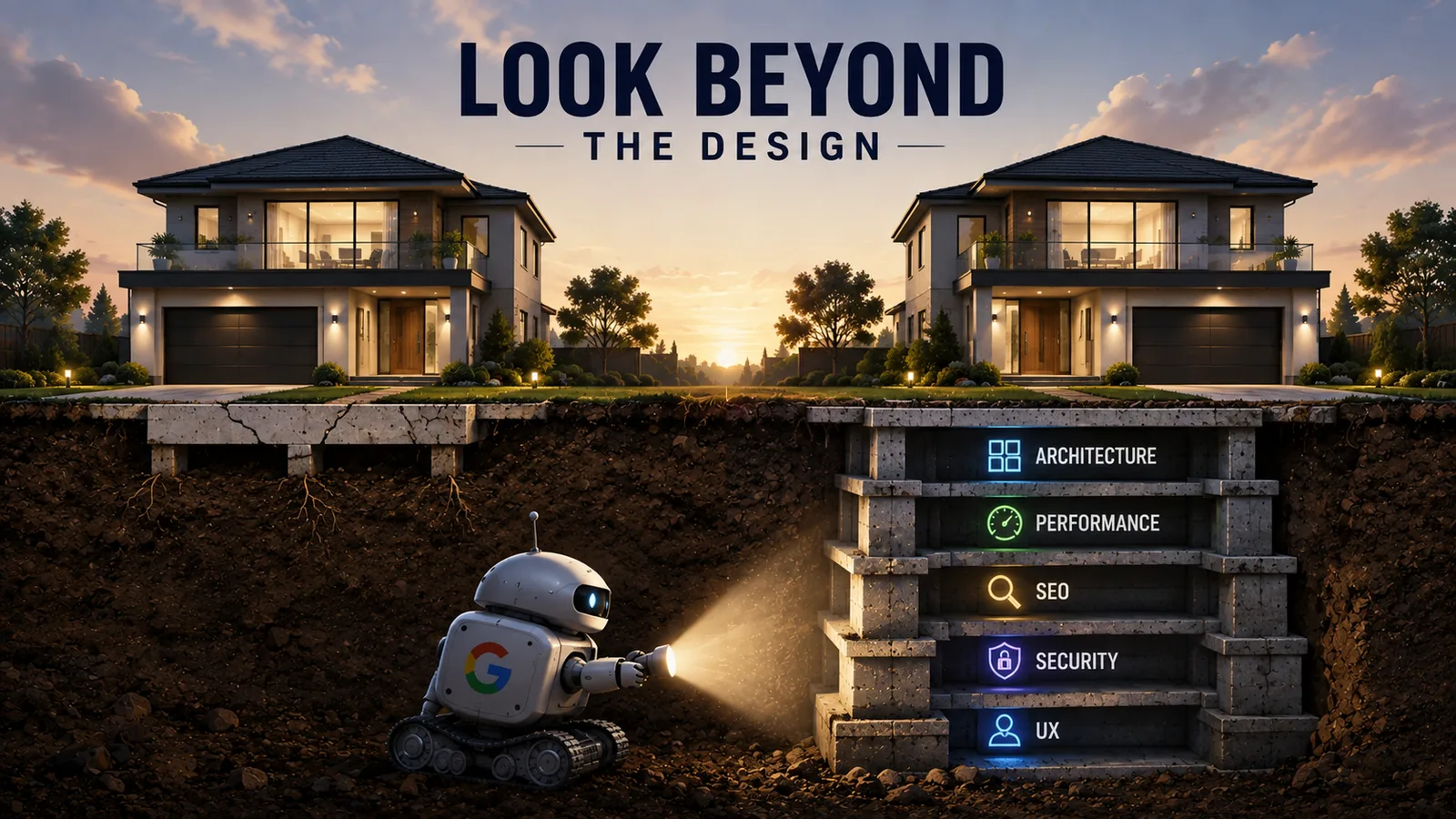
At first glance, two websites can look almost identical. Both feature modern layouts. Both use professional photography. Both include smooth animations, clean typography, and well-designed landing pages. To most visitors, they appear equally polished.
Yet one website attracts a few hundred organic visitors each month, while the other consistently generates tens of thousands.
How is that possible?
The answer is surprisingly simple. Google doesn’t evaluate websites the way people do. Visitors notice colors, images, and visual design. Google looks beneath the surface. It evaluates the site’s architecture, the quality of its code, how information is organized, its performance, its user experience, and — perhaps most importantly — the countless technical decisions made during development.
Those decisions are almost invisible to users. But they often determine whether a website earns first-page rankings — or remains practically invisible.
Over the last decade, building websites has become dramatically easier. Today, almost anyone can purchase a WordPress template, install a few plugins, and publish a professional-looking website within hours. That’s undoubtedly a positive development: it has lowered costs and made an online presence accessible to millions of businesses.
But it has also created a dangerous misconception. Many business owners assume that if two websites look similar, they’ll perform similarly. In reality, the opposite is often true. The differences that matter most aren’t the ones your customers notice. They’re the ones Google measures. And those differences begin long before the website goes live.
That’s why two companies in the same industry — with similar services and nearly identical-looking websites — can achieve completely different levels of organic visibility. Not because one chose a better template, but because one built a website to exist online, while the other built a website to perform online.
In this article, we’ll explore the difference. Not from the perspective of design, but from the perspective of software architecture, technical SEO, and the invisible engineering decisions that separate websites that simply exist from websites that consistently generate traffic, leads, and business growth.
1. Great websites begin with the people who build them
From the outside, building a website often looks straightforward. Create a design. Develop a few pages. Add a contact form. Publish.
In reality, two development teams can receive exactly the same project brief and deliver two completely different products. Not because they use different technologies. And not because one team writes code faster. The difference lies in the decisions they make.
A junior developer often sees a website as a collection of pages that need to function correctly. An experienced software engineer sees something entirely different. They see a system that needs to remain fast three years from now. Easy to maintain. Simple to expand. Secure. Search-engine friendly. Accessible across every device.
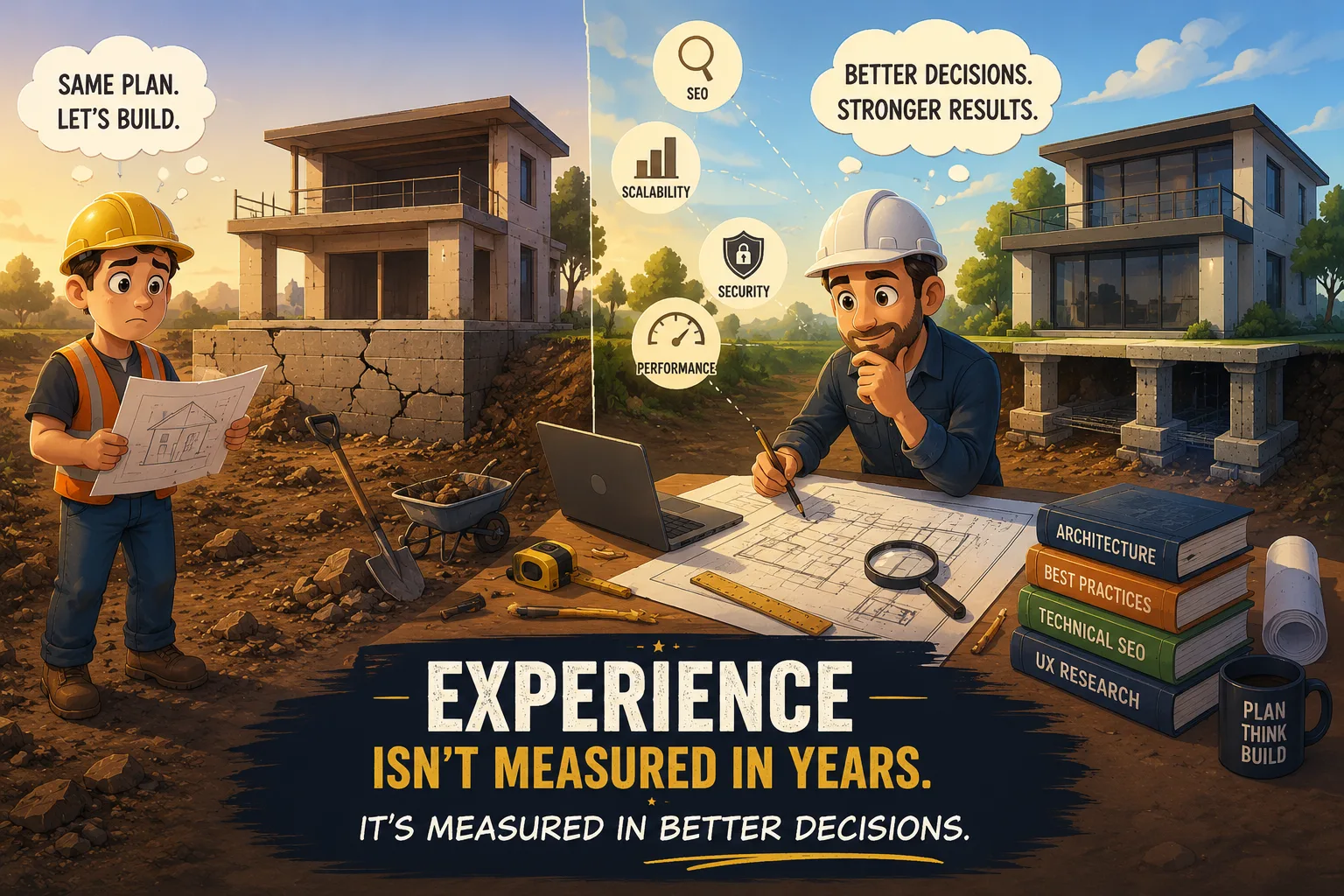
In other words, experienced engineers don’t build only for launch day. They build for everything that happens afterward. That is one of the greatest advantages experience brings to software development. Not speed — foresight. The ability to recognize future problems before they become expensive.
Most of these decisions are invisible. Clients rarely notice them. They don’t appear in screenshots. They aren’t discussed during product demonstrations. Yet they influence every future update, every SEO improvement, every new feature, and every performance optimization.
A successful website isn’t the result of one brilliant decision. It’s the result of hundreds — or even thousands — of small decisions made correctly from the very beginning.
2. Google sees what users never notice
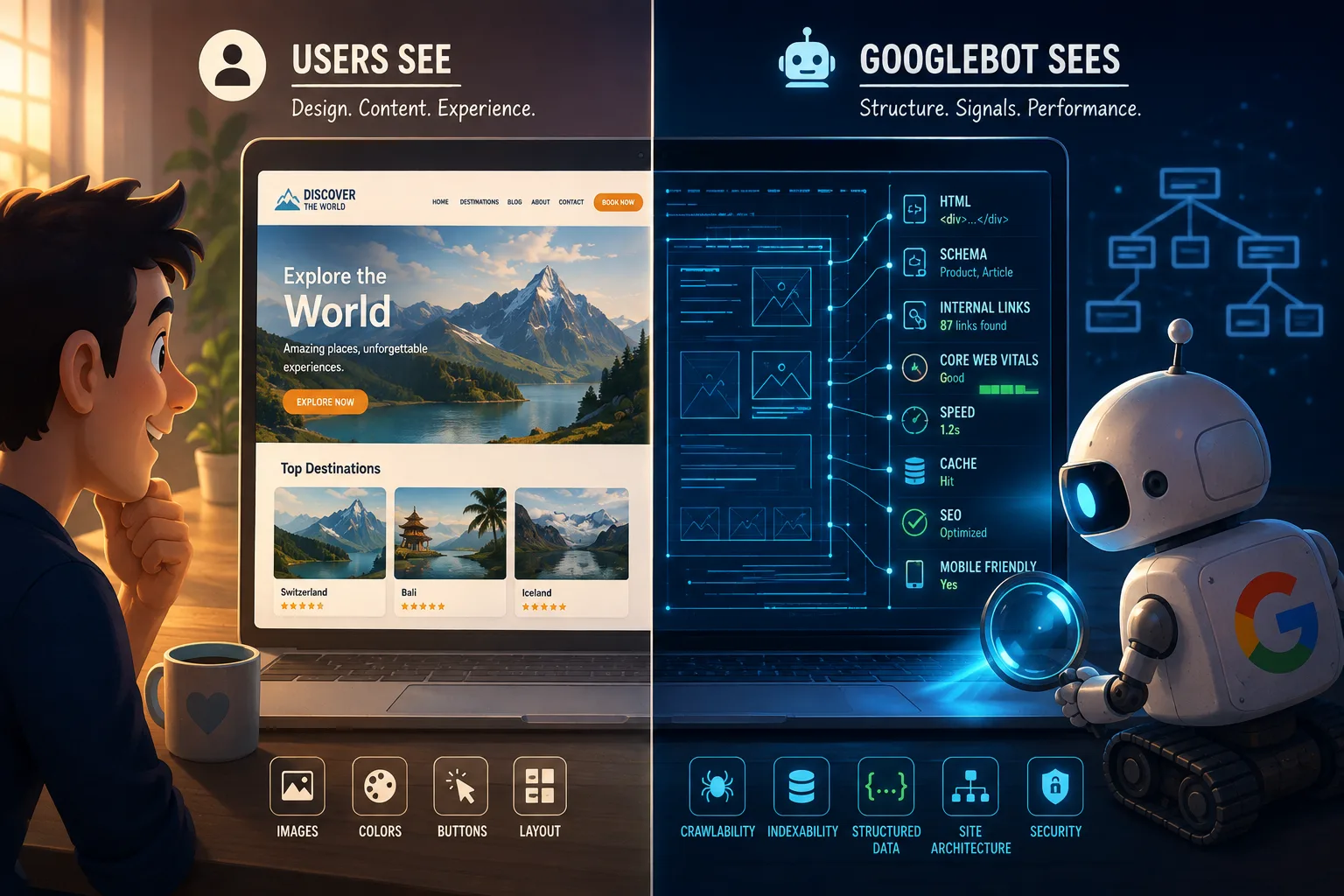
Most people evaluate a website within seconds. They notice the design, the photography, the typography, the animations. Perhaps even how quickly the homepage loads.
Google evaluates something entirely different. Search engines aren’t impressed by modern layouts or beautiful templates. They analyze the quality of the implementation: how fast the website loads, how it’s structured, how accessible it is, how well it performs on mobile devices, how information is organized, how easily it can be crawled, and how effectively it helps users find what they’re looking for.
These signals may be invisible to visitors. But together they determine whether a website deserves visibility in search results. That’s why two websites that appear almost identical can produce dramatically different outcomes. One attracts a few hundred organic visitors every month. The other consistently generates tens of thousands. Not because it’s more attractive, but because it was built in a way that search engines can understand, evaluate, and trust.
Modern SEO has evolved far beyond keywords. Today’s search engines try to understand context, relationships between pages, site architecture, content quality, user experience, and the overall credibility of the website. That means technical quality is no longer a competitive advantage. It’s a requirement.
Technical SEO: the foundation nobody sees
When people hear the term SEO, they often think about keywords, blog articles, meta titles, and meta descriptions. Those elements certainly matter. But they only become valuable if search engines can successfully discover and understand your content in the first place.
That’s where technical SEO begins. Technical SEO isn’t about manipulating Google’s algorithms. It’s about removing obstacles — helping search engines crawl your website efficiently, understand its structure, interpret its content correctly, and identify which pages deserve the most attention.
A website may have outstanding content and exceptional design. But if Google struggles to crawl, interpret, or index its pages, that quality never reaches potential visitors. This is one of the biggest reasons template-based websites often struggle to compete with websites that are strategically engineered from the beginning. The template itself isn’t the problem. The problem is stopping at what users see while ignoring what search engines evaluate.
Every website has two audiences
One of the biggest misconceptions in web development is believing that websites are built only for people. They’re not. Every successful website serves two audiences simultaneously.
The first is obvious: human visitors. They need to find information quickly, navigate intuitively, and complete their goals with minimal effort.
The second audience is Google’s crawler. It needs to understand what the website is about, how pages relate to each other, which content is most important, and how the site’s information is organized.
When both audiences are considered from the very beginning of development, the result is a website that doesn’t just look professional. It performs professionally. Because beautiful design may persuade someone to stay for a few seconds. Strong technical architecture gives Google a reason to recommend that website for years.
Key takeaway: users judge what they can see. Google evaluates what they can’t. The websites that consistently rank well aren’t simply better looking — they’re better engineered.
3. Technical SEO: the details Google measures
Before Google can decide whether a page deserves to rank, it first needs to do something much simpler: discover it, understand it, and trust it. That’s the role of technical SEO — and the details below are where it’s won or lost. It doesn’t produce overnight results. Instead, it creates the foundation that allows every other marketing effort to perform better.
Google doesn’t automatically discover every page
One of the most common misconceptions is that publishing a page automatically means Google knows it exists. It doesn’t. Google uses automated software known as crawlers to continuously explore the web, deciding which pages deserve to be crawled, indexed, and updated. That process consumes time and computing resources. For that reason, every website operates within what’s commonly called a crawl budget.
In simple terms, Google doesn’t spend unlimited resources exploring every page on every website. If a site contains hundreds of duplicate pages, automatically generated URLs, unnecessary filters, or low-value content, Google may spend a significant portion of its crawl budget exploring pages that provide little value. The consequence is straightforward: your most important pages may be discovered and indexed much more slowly.
A strategically engineered website avoids this problem. Its structure is clean. Its navigation is logical. Unnecessary pages are eliminated. Important content is easy to reach. Instead of forcing Google’s crawlers to search through noise, it guides them directly toward the pages that matter most.
Structured data: speaking Google’s language
Another technical element that most visitors never notice is structured data, commonly implemented using Schema.org. Think of structured data as an additional layer of communication between your website and search engines. Instead of forcing Google to guess what a page represents, structured data explains it directly.
A page can explicitly identify itself as a product, a business, a hotel, a restaurant, an article, an event, or dozens of other content types. That additional context helps Google interpret content far more accurately.
Structured data doesn’t guarantee higher rankings. But it often enables rich results — enhanced search listings that display review stars, prices, FAQs, availability, locations, and other useful information directly in search results. Those enhancements frequently improve click-through rates without changing ranking position. In other words, sometimes visibility improves simply because search results become more useful.
Internal links build context
A high-performing website isn’t simply a collection of pages. It’s a connected system. Internal links help visitors navigate naturally from one topic to another. They also help search engines understand how different pieces of content relate to each other.
Unfortunately, many template-based websites have almost no internal linking strategy. The homepage links to a few service pages. Everything else exists in isolation.
Strategically designed websites work differently. Blog articles connect to services. Services link to case studies. Case studies lead to contact pages. Related content reinforces other related content. The result is an ecosystem that makes sense — for users and search engines alike. Instead of isolated pages competing independently, the entire website begins working as one connected structure.
Trust has become an SEO signal
Technical quality alone is no longer enough. Modern search engines increasingly try to answer another question: “Can this website be trusted?”
That’s why Google’s concept of E-E-A-T — Experience, Expertise, Authoritativeness, and Trustworthiness — has become increasingly important. Anonymous websites with no identified authors, no case studies, and no evidence of real-world expertise naturally inspire less confidence.
Websites that clearly present their team, their experience, their projects, client testimonials, and their industry expertise send a completely different signal. Not only to visitors, but to search engines as well. Modern SEO is no longer just about optimization. It’s about credibility. Search engines increasingly reward websites that demonstrate genuine expertise instead of simply repeating keywords.
Key takeaway: technical SEO isn’t about finding shortcuts around Google’s algorithms. It’s about building websites that are easy to discover, easy to understand, and trustworthy enough for search engines to confidently recommend to their users.
4. Why two nearly identical websites can generate ten times more traffic
This is probably the question we hear most often. How can two companies in the same industry, offering similar services and operating websites that look almost identical, achieve completely different results in Google?
At first glance, the differences seem insignificant. Both websites have modern designs. Both use professional photography. Both present their services clearly. To the average visitor, the experience feels almost identical.
And yet one website attracts a few hundred organic visitors each month, while the other consistently generates tens of thousands. The difference isn’t the design. It isn’t the template. And it certainly isn’t the color palette. The difference lies in the strategy behind the website.
A website can be built to exist — or built to perform
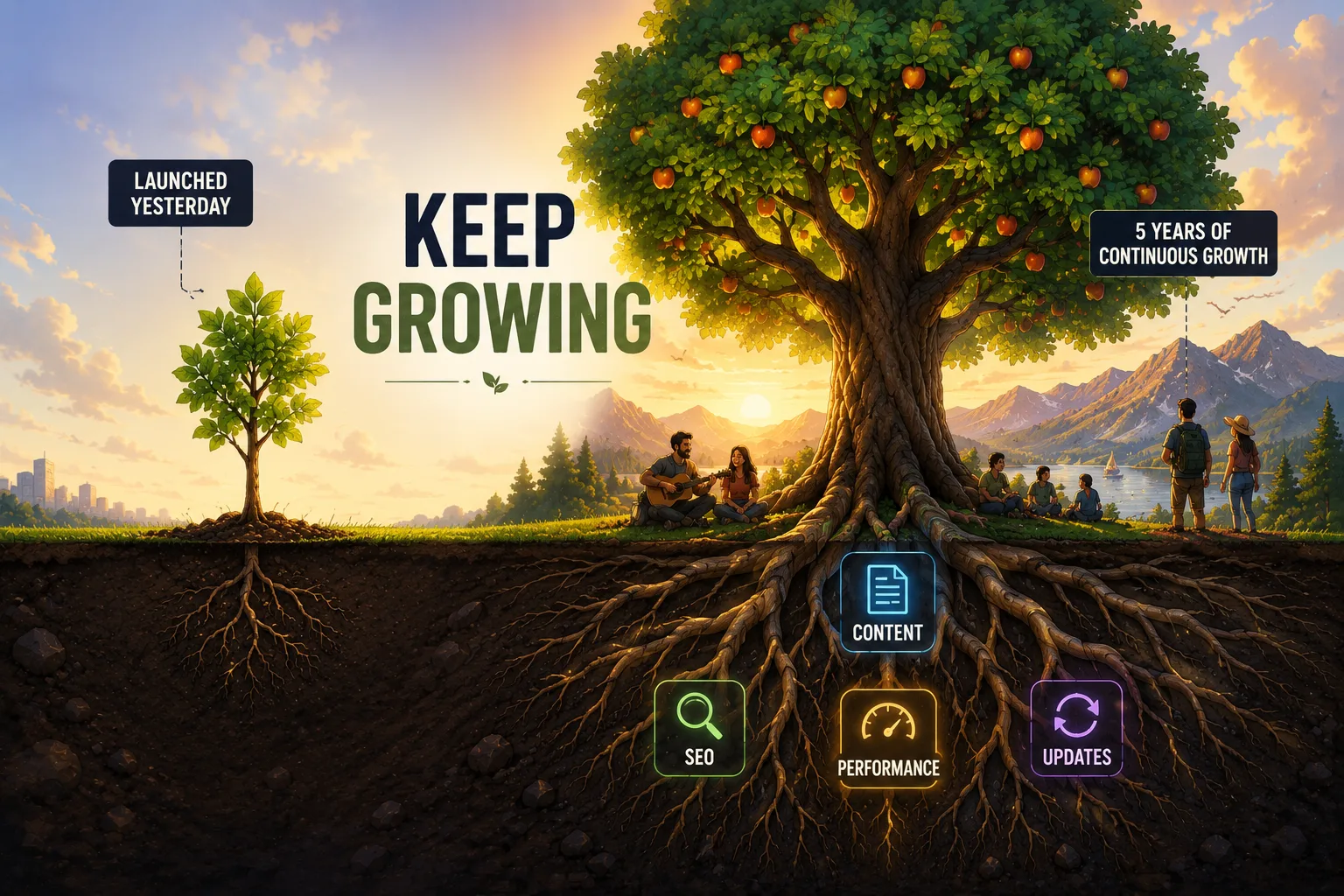
This is perhaps the single biggest distinction between an ordinary website and a high-performing one. Some websites are built with one objective: to have an online presence. Others are built with a very different goal: to generate measurable business results.
That difference influences every decision made during development. A website built simply to exist usually has a handful of pages, very little content, infrequent updates, a basic structure, and almost no performance measurement.
A website built for long-term growth looks completely different. It isn’t launched and forgotten. It is measured, improved, expanded, and optimized — continuously. The launch is not the finish line. It’s the starting point.
Small improvements become massive advantages
The biggest differences between successful websites rarely appear overnight. At the beginning, they seem almost invisible. One business publishes one useful article every month; another publishes one article every year. One continuously improves loading speed; the other assumes the website is already “finished.” One monitors Core Web Vitals; the other never checks performance after launch. One analyzes user behavior; the other relies entirely on assumptions.
Individually, none of these decisions seems dramatic. Collectively, they transform the website over time: more useful content, more indexed pages, better internal linking, greater authority, more opportunities to appear in search results.
Organic growth rarely comes from one breakthrough optimization. It comes from hundreds of small improvements, applied consistently over months and years.
A website isn’t a project. It’s a business asset.
One of the most expensive misconceptions in digital business is treating a website like a project. A budget is approved. The website is built. It goes live. The project is considered complete.
High-performing companies think differently. They treat their website as an asset. Just like investing in employees, equipment, or product development, investing in a website creates long-term returns.
Every new article. Every technical improvement. Every additional landing page. Every second removed from loading time. Every improvement to the user experience. Each one increases the website’s long-term ability to attract customers. The websites dominating Google’s search results today weren’t perfect when they launched. They simply never stopped improving.
Long-term thinking always wins
The companies that consistently succeed in organic search rarely have a secret advantage. They simply think differently. They don’t ask, “How quickly can we launch?” They ask, “How valuable can this website become over the next five years?”
That mindset changes everything. Instead of viewing a website as a completed project, they treat it as an evolving product — one that grows stronger with every improvement, every article, every optimization, every new insight. Over time, those small improvements compound. And compounding is one of the most powerful forces in digital marketing.
Conclusion
Building a website has never been easier. Today, almost anyone can install a template, publish a professional-looking website, and establish an online presence within days. But the gap between having a website and owning a website that consistently generates business results has never been wider.
Online success isn’t determined by the template you choose. It’s determined by the invisible decisions made throughout the entire development process: software architecture, technical performance, user experience, high-quality content, technical SEO, and continuous improvement. Together, these elements transform a website from a digital brochure into one of the most valuable marketing assets a company can own.
A concrete example of that difference: in our Elmadenta case study we took the Google PageSpeed score from 59 to 99 by rebuilding the technical foundation correctly.
A great website works every day. It attracts organic traffic, builds credibility, generates qualified leads, and continues creating value long after development has ended.
So perhaps the real question isn’t “Which template should we choose?” A better question is: “Are we building a website that simply exists — or one that will continue delivering measurable business results for years to come?”
Because in the end, the biggest differences between websites aren’t visible on the screen. They’re visible in the results they produce.
Key takeaway: great websites aren’t defined by how they look. They’re defined by how they’re engineered, how they’re maintained, and how consistently they create value over time. Design captures attention. Strategy earns visibility. Engineering sustains growth.