Why Developer Experience Matters More Than the Technology
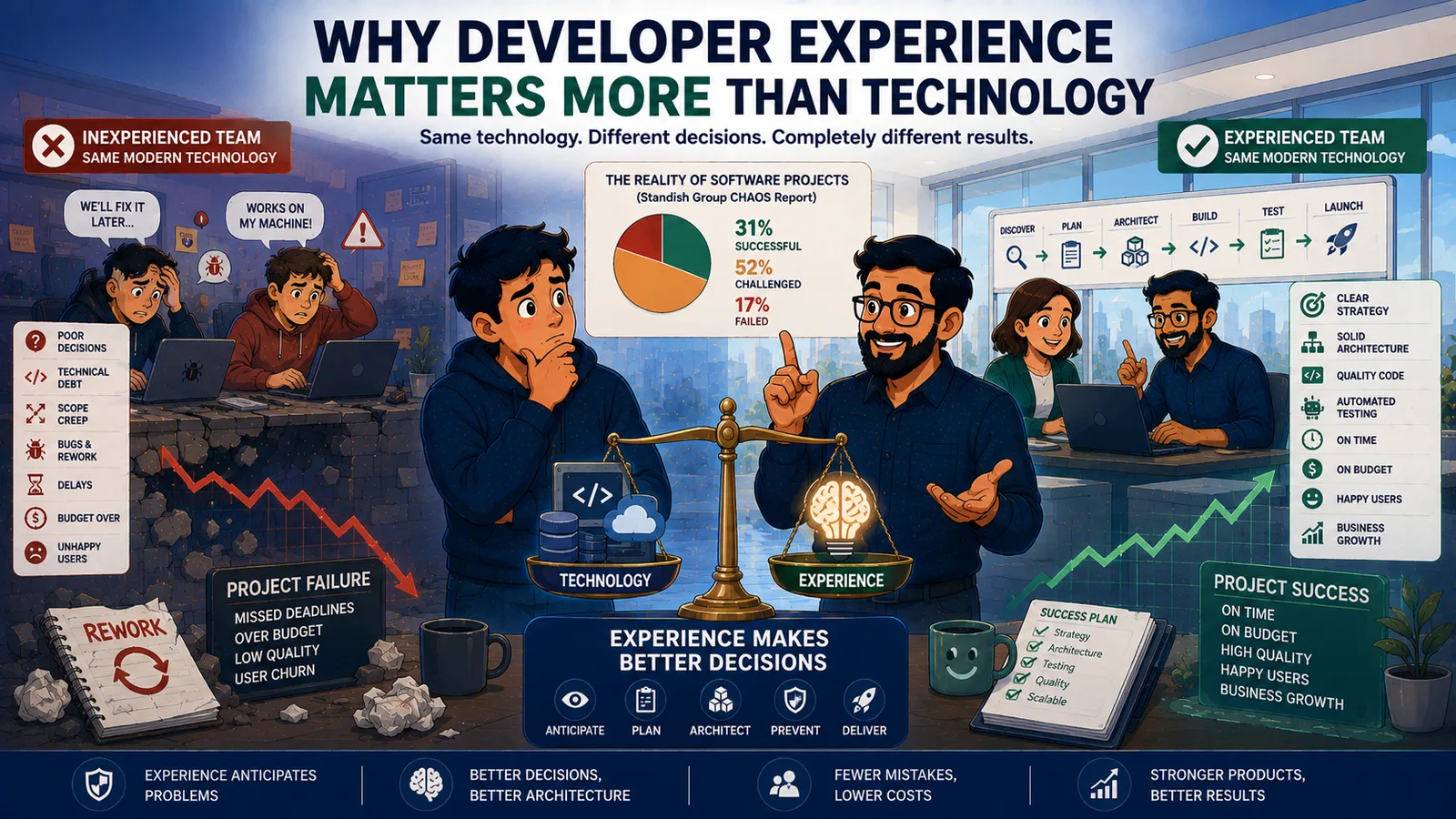
Every year brings a new “must-use” technology. A faster framework, a smarter database, a trendier language. It’s tempting to believe that the right tool is what separates a great product from a failed one. But if you look at the data on why software projects actually succeed or fail, a different picture emerges: the biggest variable is almost never the technology. It’s the people making the decisions.
Technology changes. Judgment endures.
Tools come and go. The framework everyone praised five years ago is often the one teams are migrating away from today. What doesn’t expire is engineering judgment — knowing which problem to solve first, where the risks hide, and which “clever” shortcut will quietly become next year’s emergency.
An experienced engineer and a beginner can be handed the exact same modern stack and produce wildly different results. Not because one typed faster, but because experience changes every decision made along the way: how data is structured, how failure is handled, how the system will behave under real load.
What the data says about software projects
The numbers here are sobering, and they’ve been consistent for decades.
The most cited long-term research, The Standish Group’s CHAOS reports, has repeatedly found that only around a third of software projects are delivered successfully, while the majority are “challenged” (late, over budget, or missing features) or fail outright. Newer technology has not moved this needle much — the failure modes are overwhelmingly about people, planning and decisions, not tools.
A landmark study by McKinsey & Company with the University of Oxford, analyzing 5,400 large IT projects, found that on average they ran 45% over budget and 7% over time, while delivering 56% less value than predicted. The projects that stayed on track weren’t the ones with the fanciest technology — they were the ones with strong technical direction and experienced teams making disciplined trade-offs.
The real, measurable cost of getting it wrong

Poor engineering isn’t just an abstract risk — it has a price tag, and it’s enormous.
Back in 2002, a National Institute of Standards and Technology (NIST) study estimated that inadequate software testing alone cost the US economy around $59.5 billion per year. Two decades later, the Consortium for Information & Software Quality (CISQ) estimated the total cost of poor software quality in the US at roughly $2.08 trillion in 2020 — driven largely by failed projects, legacy problems and defects that experienced review would have caught early.
There’s a well-established principle behind those numbers: the later a problem is discovered, the more it costs to fix. A flaw caught during design is cheap. The same flaw discovered in production — after customers hit it — can cost orders of magnitude more. Experience is what moves those catches earlier.
Why two engineers can differ by 10x
One of the oldest and most striking findings in software research is how much individual developers vary. Early studies of programmer productivity (Sackman, Erikson and Grant, 1968) found differences of more than 10x between individuals working on the same task — a result later popularized in Fred Brooks’ classic The Mythical Man-Month.
Crucially, that gap wasn’t about typing speed or raw intelligence. It was about experience and approach: the best engineers chose better designs, avoided dead ends and wrote code that others could build on. Decades later, DeMarco and Lister’s Peopleware reached a similar conclusion — the differences between teams dwarf the differences between tools.
It’s capabilities, not the tech stack
Perhaps the strongest modern evidence comes from DORA (DevOps Research and Assessment), the multi-year research program behind the book Accelerate and Google’s annual State of DevOps reports. Studying thousands of organizations, DORA consistently found that the highest-performing teams deploy far more frequently, fail far less often and recover from incidents dramatically faster than low performers.
The key insight: these outcomes are predicted by capabilities and practices — testing, automation, architecture, clear ownership — not by which specific tools or languages a team happened to pick. Those capabilities are exactly what experience builds.
What experience actually buys you
So what does an experienced team give you that a newer one, using the same technology, cannot? In practice, it’s this:
- Anticipation. Spotting the problem before it becomes expensive, instead of reacting after it does.
- Better trade-offs. Knowing when “good enough” is right and when it’s a trap.
- Fewer dead ends. Avoiding architectures that work in the demo and collapse in production.
- Calm under real conditions. Handling messy data, edge cases and scale — the parts users actually hit.
- Lower total cost. Because the expensive mistakes are the ones that never get made.
None of this appears in a feature list or a technology logo. All of it shows up in the months and years after launch.
Conclusion
Technology matters — but it’s a tool, and tools are only as good as the hands holding them. The data is remarkably consistent: projects don’t succeed because of the framework, and they don’t fail because of it either. They rise or fall on the experience, judgment and discipline of the people building them.
At theCoders, we choose technology carefully — and then we let experience do the heavy lifting. Because in the end, the most important decision isn’t which tool you use. It’s who is deciding how to use it.
Sources
- The Standish Group — CHAOS Report (software project success and failure rates)
- McKinsey & Company and the University of Oxford — Delivering large-scale IT projects on time, on budget, and on value (2012)
- National Institute of Standards and Technology (NIST) — The Economic Impacts of Inadequate Infrastructure for Software Testing (2002)
- Consortium for Information & Software Quality (CISQ) — The Cost of Poor Software Quality in the US (2020)
- N. Forsgren, J. Humble, G. Kim — Accelerate and the DORA / State of DevOps reports
- Sackman, Erikson & Grant (1968), on programmer productivity variance; discussed in F. Brooks, The Mythical Man-Month
- T. DeMarco & T. Lister — Peopleware: Productive Projects and Teams