What Code Review Really Is — and Why It Matters So Much
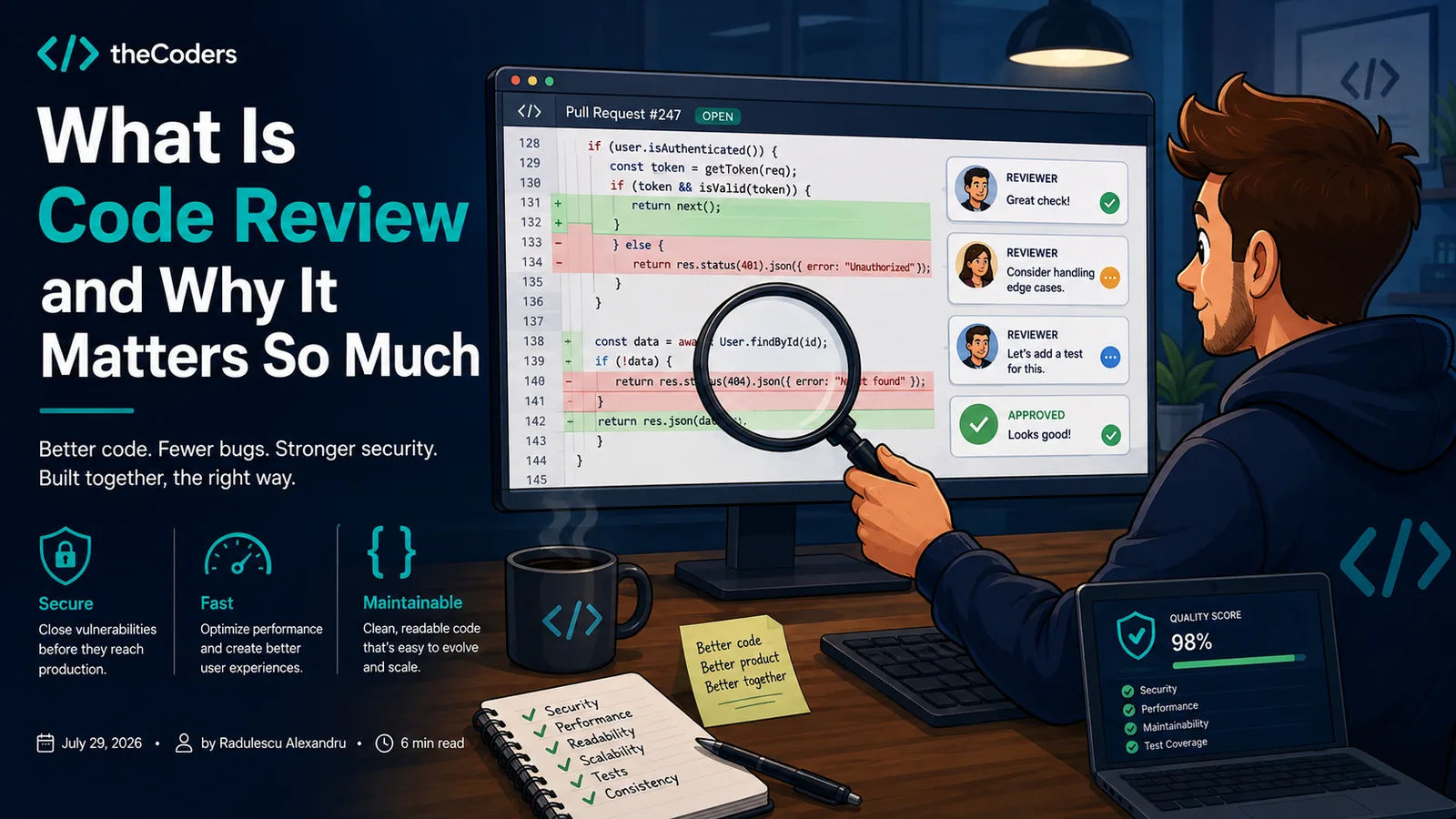
If you’ve ever worked with a software team, you’ve probably heard the phrase “it’s in review.” It sounds like a small, routine step. In reality, code review is one of the most important moments in the entire development process — the point where quality, security and long-term stability are actually decided.
Here’s the simplest way to think about it: before any new code becomes part of a live product, another engineer reads it, questions it and improves it. Nothing ships until a second pair of eyes has looked at it carefully. It’s the software equivalent of a pilot’s pre-flight checklist — quietly essential, even when everything looks fine on the surface.
More than “finding bugs”
Many people assume code review is only about spotting mistakes. Catching bugs early is a big part of it, but the real value goes much deeper. A good review asks a series of questions that a user will never see, yet will always feel:
- Is this code secure, or does it open a door for attackers?
- Will it stay fast as data and traffic grow?
- Can another developer understand and change it in a year, without breaking it?
- Does it handle the messy, real-world cases — empty fields, slow networks, unexpected input?
- Is it consistent with the rest of the codebase, or a one-off that will confuse everyone later?
None of these show up in a screenshot. All of them decide whether a product stays healthy or slowly turns into something nobody wants to touch.
Why the code underneath matters — from every angle
A website or app can look identical on the surface and be completely different underneath. That invisible layer is where the real differences live.
Security
This is the one that keeps us most alert. A single overlooked line can expose user data, leak passwords or let an attacker slip through. Review is where we check how input is validated, how data is stored, how authentication works and whether any dependency has known vulnerabilities. Security problems are cheap to fix in review and extremely expensive to fix after a breach. For AI-generated code, those checks matter even more.
Performance and optimization
Fast software isn’t an accident — it’s the result of hundreds of small decisions. In review we look at how the database is queried, how images and assets are loaded, whether anything is being recalculated needlessly and how the page behaves on a mid-range phone, not just a developer’s powerful laptop. A few milliseconds here and there add up to the difference between a site that feels instant and one that feels sluggish. That exact kind of work took the Google PageSpeed score from 59 to 99 in our Elmadenta case study.
Maintainability and readability
Code is read far more often than it is written. If it’s clear and well structured, future changes are quick and safe. If it’s tangled, every small update becomes risky and slow — and costs pile up month after month. Review is where we keep the code understandable for the next person, who is very often ourselves, six months later.
Scalability
The code that works for a hundred users can quietly fall apart at ten thousand. A good review anticipates growth: will this structure hold up when the business succeeds? Building that headroom in early is far cheaper than rebuilding under pressure later.
Correctness and edge cases
Happy-path code — where everything goes as expected — is the easy part. Real users don’t follow the happy path. They lose connection, paste strange characters, double-click buttons and open ten tabs at once. Review is where we make sure the software behaves gracefully when reality gets messy.
What a thorough review actually checks
Behind the scenes, a solid review runs through a mental checklist that touches almost every quality of the product:
- Security — input validation, authentication, data protection, dependency risks
- Performance — database queries, caching, asset loading, render speed
- Accessibility — can everyone use it, including with a keyboard or screen reader?
- SEO fundamentals — clean structure, correct markup, fast loading
- Error handling — what happens when something fails?
- Readability — clear names, sensible structure, no hidden surprises
- Consistency — does it match the patterns used across the project?
- Tests — is the important behavior protected against future changes?
Each item is small on its own. Together, they are the difference between software that merely works today and software that keeps working — safely — for years.
Why this matters for the business, not just engineers
It’s easy to see code review as an internal, technical detail. But every point above translates directly into business outcomes. Secure code protects your customers and your reputation. Fast code keeps visitors from leaving. Maintainable code means new features cost less and arrive sooner. Scalable code means success doesn’t break your platform.
In other words, the review process that happens quietly before launch is one of the biggest factors in what your product will cost — and earn — over the years that follow.
Our promise: a complete code audit at delivery
We believe you shouldn’t have to take any of this on faith. That’s why, at the end of a project, we don’t just hand over a working website or application — we hand over a complete audit of the code.
This audit lays out, in plain language, every area we reviewed and optimized: the security measures in place, the performance work done, how the code is structured, how it’s protected against errors, the accessibility and SEO foundations, and the decisions we made along the way. You get a clear picture of exactly what was checked, what was improved and why — so you know precisely what you own and the shape it’s in.
For us, this is a matter of transparency and respect. Your website is a serious investment, and you deserve to understand its foundations, not just its surface.
Final thoughts
Code review is where good software quietly becomes great — where security holes are closed, speed is protected and tomorrow’s changes are made safe today. It’s the least visible part of building a product and one of the most important.
At theCoders, we treat it that way: as a core part of engineering, not an afterthought — and we finish every project by showing you exactly what we found, fixed and future-proofed.