AI Security: What Development Teams Should Actually Do
The solution isn’t to ban AI coding tools. That would be both unrealistic and counterproductive.
Modern AI assistants provide undeniable value. They eliminate repetitive work, accelerate prototyping, generate documentation, write unit tests, and help developers become productive with unfamiliar technologies much faster. Used correctly, they can significantly improve engineering efficiency and reduce development time.
The real question isn’t whether organizations should adopt AI. It’s how they should adopt it.
The companies successfully integrating AI into their software development lifecycle all share one principle:
They treat AI as a highly capable development assistant — not as a replacement for experienced software engineers.
That distinction shapes every security decision that follows.
1. Make security reviews mandatory for AI-generated code
Every pull request containing AI-generated or AI-assisted code should undergo the same level of security scrutiny as manually written code — and in many cases, even more.
Today’s AI models excel at producing clean, readable, well-structured implementations. Ironically, that is exactly what makes them dangerous. Well-formatted code naturally inspires confidence, making reviewers more likely to focus on style, architecture or performance while overlooking security flaws.
During every code review, engineers should explicitly verify:
- Authentication and authorization logic
- Input validation
- SQL Injection and Cross-Site Scripting (XSS) risks
- Error and exception handling
- Hardcoded credentials or secrets
- User permissions and privilege boundaries
- API endpoint protection
- File upload security
- Access to sensitive resources
The purpose of a code review isn’t simply to confirm that an application works. It’s to ensure the application stays secure — even when someone intentionally tries to break it.
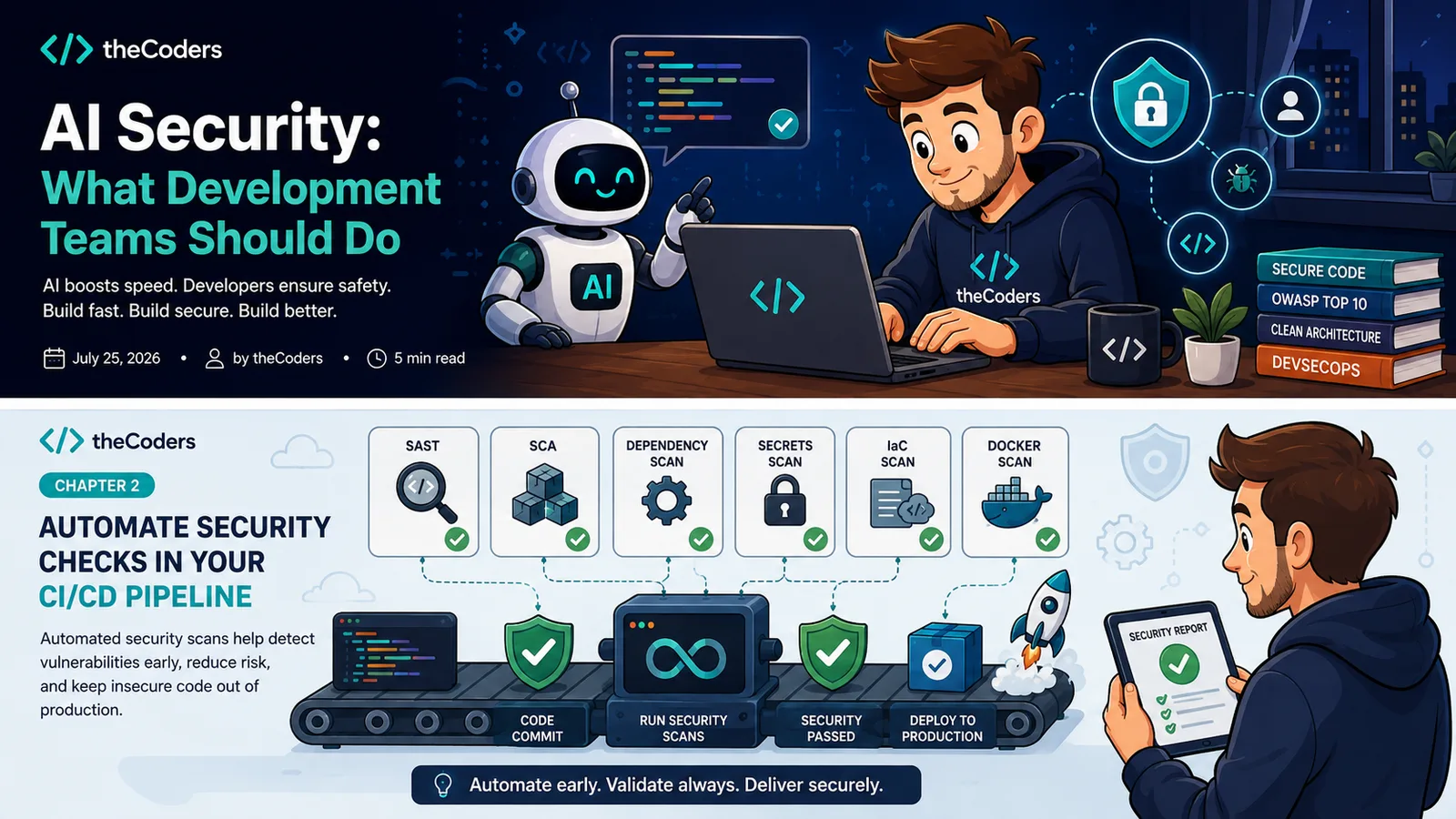
2. Automate security testing throughout your CI/CD pipeline
Manual reviews alone are no longer enough. Modern teams generate thousands of lines of code every day, and AI accelerates that further, making it impossible for human reviewers to thoroughly inspect every change.
Automated security testing should be integrated directly into every deployment pipeline. A modern CI/CD workflow should include at least:
- Static Application Security Testing (SAST)
- Software Composition Analysis (SCA)
- Open-source dependency vulnerability scanning
- Secret detection
- Infrastructure-as-Code security scanning
- Container image scanning
These checks should run automatically before every deployment — not afterward.
Automation will never replace experienced security engineers. But it dramatically reduces the number of obvious vulnerabilities that reach production, and frees reviewers to focus on higher-level architectural risk. Think of it as your first line of defense, not your only one.
3. Define your threat model before asking AI to write code
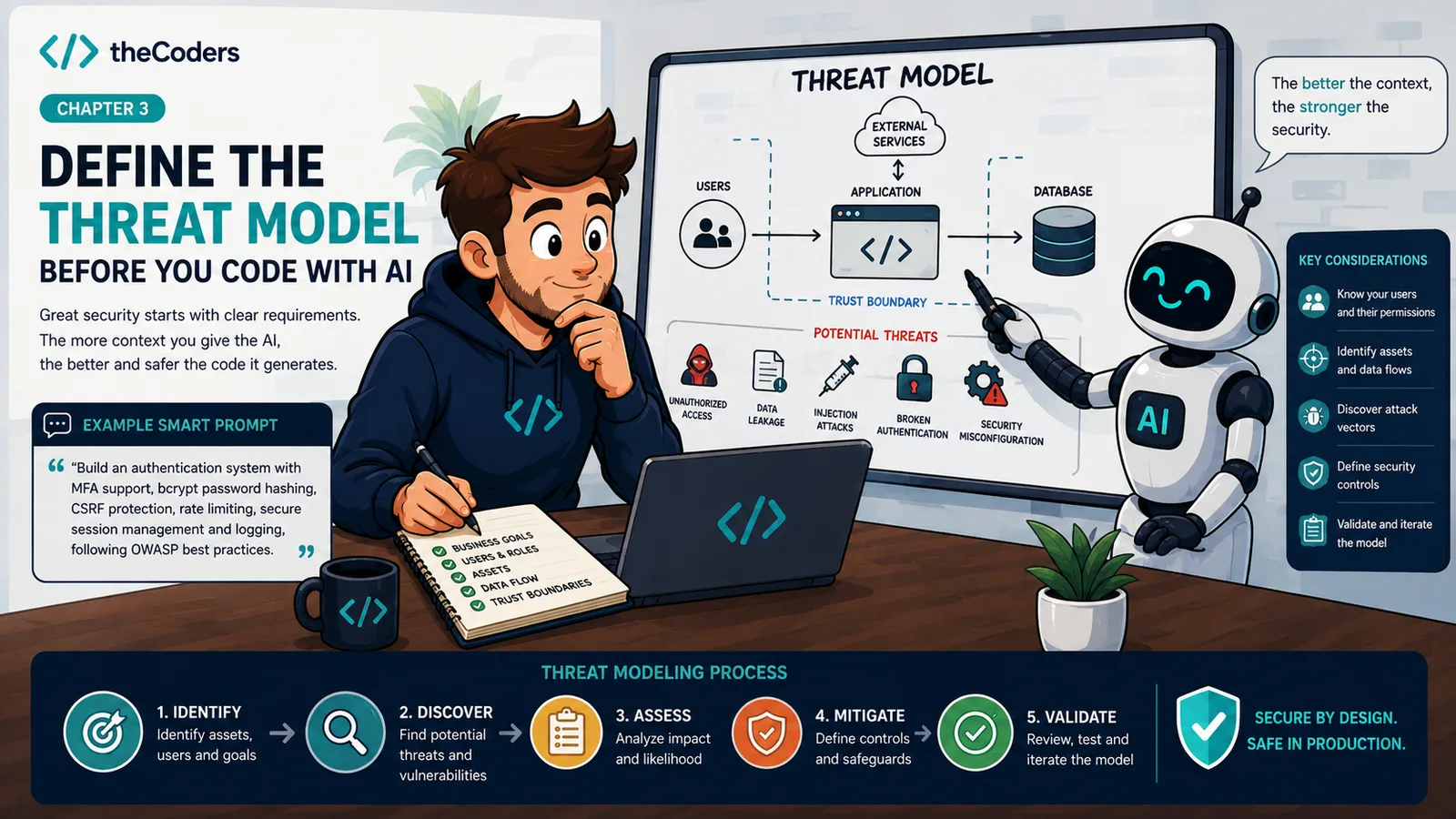
One of the most common mistakes is writing overly generic prompts. Consider the difference between these two requests:
“Build a login system.”
versus
“Build a login system with multi-factor authentication, bcrypt password hashing, CSRF protection, rate limiting, secure session management and audit logging, following OWASP recommendations.”
The second prompt establishes security expectations from the start. By giving the model architectural constraints up front, you are far more likely to receive an implementation aligned with modern best practices.
Even then, every generated line should still be reviewed and tested. But AI performs significantly better when security requirements are part of the original specification instead of being bolted on afterward.
4. Treat “vibe coding” as rapid prototyping
The rise of vibe coding shows just how accessible software development has become. Today it’s entirely possible to build a working MVP over a single weekend using almost nothing but AI. That’s impressive — and also potentially dangerous.
AI-generated applications are excellent for proofs of concept, rapid idea validation, internal tools, hackathons, prototypes and early user testing.
They should not automatically be considered production-ready — especially when they handle user accounts, personal information, financial transactions, healthcare data, confidential documents or any other sensitive information.
There is a massive difference between software that works and software that is secure. AI does not eliminate that difference.
5. Invest in developers, not just AI tools
Perhaps the most valuable long-term investment isn’t another AI subscription. It’s the engineers using it.
Many organizations spend significant budgets on AI tooling while investing very little in helping developers critically evaluate AI-generated code. In reality, software security depends far more on the quality of the review process than on the model itself.
Engineers should be trained to recognize the security issues that recur in generated code:
- Missing authorization checks
- Overly permissive configurations
- Exposed secrets
- Insufficient input validation
- Insecure dependencies
- Incorrect assumptions about user behavior
- Poor error handling
Experience consistently shows that developers trained in application security find vulnerabilities that automated scanners simply miss. AI is changing how software is written — it should also change how engineers are trained.
Conclusion
Artificial intelligence is fundamentally transforming software development. Within a few years, nearly every engineering team will rely on AI as part of its daily workflow. This is no longer a prediction; it is already happening.
Yet every major security study published through 2026 reaches the same conclusion: AI accelerates software development, but it does not eliminate developers’ responsibility for security.
Modern models can generate production-quality code in seconds. What they still lack is an understanding of your application’s architecture, business rules, compliance requirements, trust boundaries and threat model. Responsibility for security still belongs to the engineering team. The only difference is that today’s engineers aren’t reviewing only human-written code anymore — they’re reviewing AI-generated code as well.
At theCoders, we use AI every day to accelerate development, automate repetitive tasks and help our engineers ship better products faster. But no model replaces the experience of a skilled software engineer or an application security specialist. Every line of code that reaches production is reviewed, tested and validated against real-world security requirements.
Because shipping software quickly is valuable. Shipping software quickly — and securely — is what creates lasting value.