AI Isn't Software. It's Business Infrastructure.
Right now, while you’re reading this article, there’s a good chance someone inside your company is already using artificial intelligence.
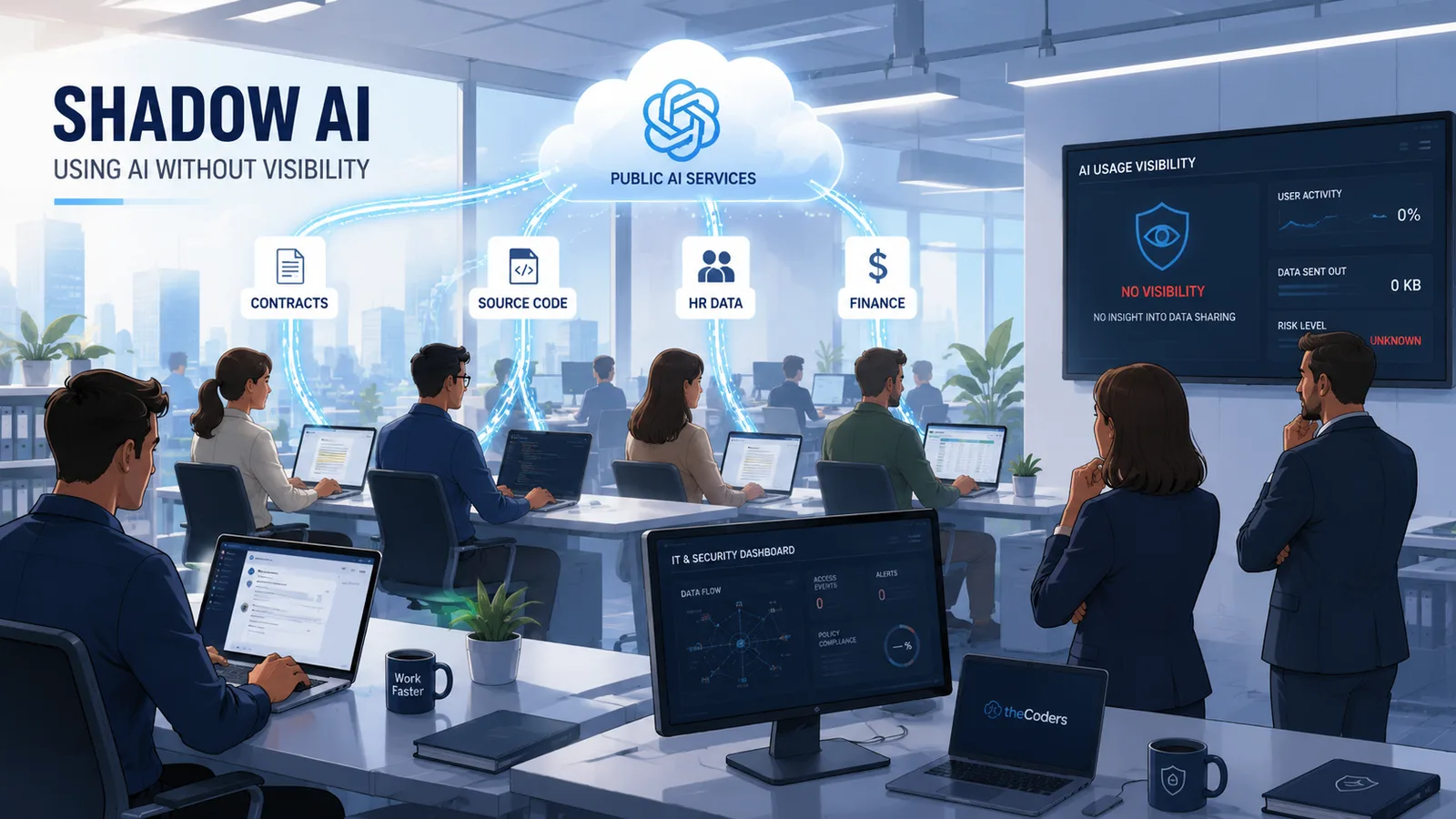
A salesperson is asking ChatGPT to rewrite a proposal. A lawyer is summarizing a confidential contract. Someone in HR is reviewing resumes containing personal information. A software engineer is pasting internal source code into an AI assistant to debug an issue.
None of this seems unusual anymore. In fact, for many organizations, AI has quietly become part of everyday work.
The problem is that, in most companies, this transformation happened without a strategy. Without governance. Without internal policies. And often without IT or executive leadership fully understanding how AI is being used — or what information is leaving the organization.
This phenomenon has a name: Shadow AI.
Over the past two years, one of the biggest challenges in enterprise AI hasn’t been the technology itself. It’s been the uncontrolled adoption of public AI services by employees. Not because people are trying to break the rules, but because they’re trying to work faster.
And that’s where many organizations make their first mistake. They believe the problem is ChatGPT. It isn’t. The real problem is the absence of an AI strategy.
AI is not an IT project
When organizations decide they want to “implement AI,” the first question is almost always the same: which model should we use? ChatGPT? Claude? Llama? Qwen? DeepSeek?
In reality, that’s one of the last questions that should be asked. The language model is only one component of the overall system.
The success of an AI initiative is rarely determined by the model itself. It’s determined by the business processes the model is designed to improve. The exact same technology can generate extraordinary results in one organization and deliver almost no value in another — not because the model changed, but because the business processes did.
That’s why we never begin AI projects by discussing language models. We begin by understanding the organization: how information flows, where time is being lost, which processes are repetitive, where bottlenecks exist, and where artificial intelligence can create measurable business value.
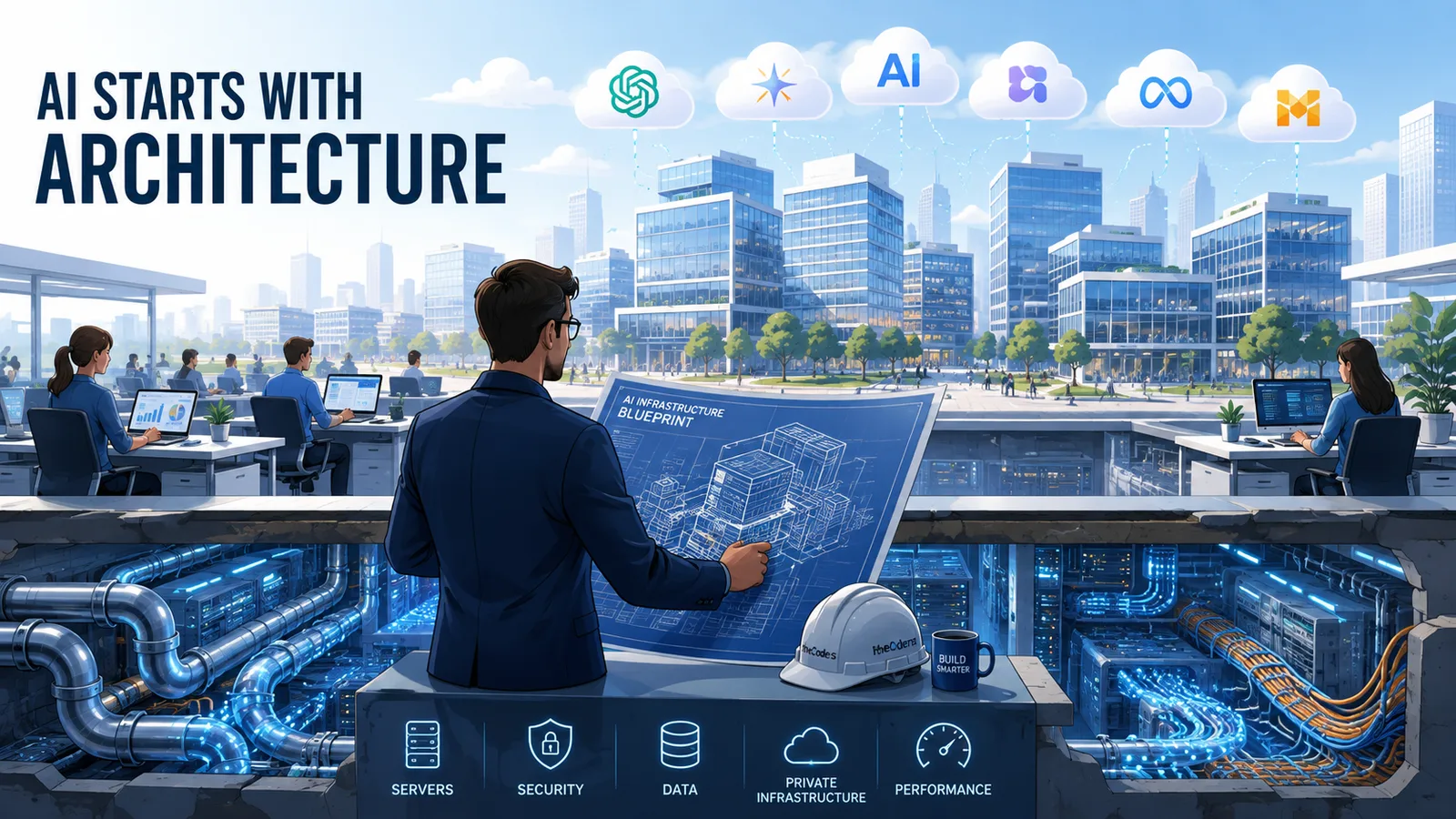
Just as an architect doesn’t begin designing a building by choosing concrete, successful AI projects shouldn’t begin by selecting a model. First, you design the architecture. Then you choose the technology.
Most AI projects don’t fail because of technology
One of the biggest misconceptions surrounding enterprise AI is that success depends primarily on choosing the most advanced language model. In practice, experience tells a very different story. Most AI initiatives struggle for reasons that have little to do with the technology itself.
The real challenges usually appear long before the first model is deployed. Company knowledge is scattered across multiple systems. Critical documents exist in different versions. Business processes have evolved over the years without standardization. Departments work in isolation. Access permissions are inconsistent. And valuable information is often locked away inside emails, PDFs, shared folders, or legacy applications.
Under these conditions, even the world’s most capable AI model will produce inconsistent results. Not because the technology is flawed, but because it has been connected to an environment that was never designed to support it.
Artificial intelligence doesn’t fix broken processes. It accelerates existing ones. If your workflows are efficient, AI makes them faster. If they’re inefficient, AI simply scales the inefficiency.
That’s why successful AI projects begin with understanding the organization — not with deploying software.
Consulting is the most valuable phase of an AI project
Many companies see technical consulting as an optional step. We see it as the foundation of the entire project.
Before discussing infrastructure, before selecting a language model, before provisioning servers, we spend time understanding how the business actually operates. We work with management teams. We analyze operational workflows. We map how information moves across departments. We identify repetitive tasks. We uncover bottlenecks. We determine where employees spend time searching for information instead of using it.
Only after understanding these processes can we determine whether artificial intelligence is the right solution — and where it can deliver the highest return on investment.
In many projects, the conclusions are surprising. Processes that management considered critical often provide relatively little opportunity for automation. Meanwhile, seemingly simple administrative activities may consume hundreds of working hours every month.
These discoveries shape the entire implementation strategy. That’s why consulting isn’t simply another service we offer. It’s the phase that reduces risk, prevents unnecessary investment, and ensures that every technical decision supports a real business objective.
Private AI is not the goal. It’s the result of good architecture.
Once business processes have been analyzed and opportunities have been identified, the next question naturally follows: where should AI run?
For many organizations, the default answer is simple: in the cloud. It’s fast, it’s easy to deploy, and it requires little upfront investment. For some businesses, that’s absolutely the right choice.
For others — particularly organizations handling confidential information, regulated data, intellectual property, or sensitive customer records — control over the infrastructure becomes just as important as the performance of the model itself.
This is where Private AI enters the conversation. Private AI isn’t a different type of artificial intelligence. It isn’t a different language model. It’s the same technology deployed within a different architectural framework. Instead of sending business-critical information to infrastructure controlled by a third party, the models operate inside the company’s own environment — whether that’s an on-premises data center, a private cloud, or dedicated infrastructure managed exclusively for the organization.
From the user’s perspective, almost nothing changes. Employees ask questions, summarize documents, analyze reports, generate content, and receive intelligent assistance. The experience feels familiar. The difference is invisible — but it’s critical.
The organization’s knowledge remains inside the organization. The company decides where data is processed, who can access it, how it is protected, and how compliance requirements are enforced.
Private AI isn’t simply about security. It’s about ownership, governance, and long-term control over one of the organization’s most valuable assets: its knowledge.
AI is only as good as the knowledge it can access
One of the most common misconceptions about artificial intelligence is that the language model itself is the most important part of the system. It isn’t. The model is simply the reasoning engine. The real value comes from the information it can understand and use.
That’s why one of the first steps in every implementation is analyzing the organization’s knowledge landscape. Where is information stored? How is it organized? Who has access to it? How many duplicate versions exist? Which documents are current, and which ones are outdated?
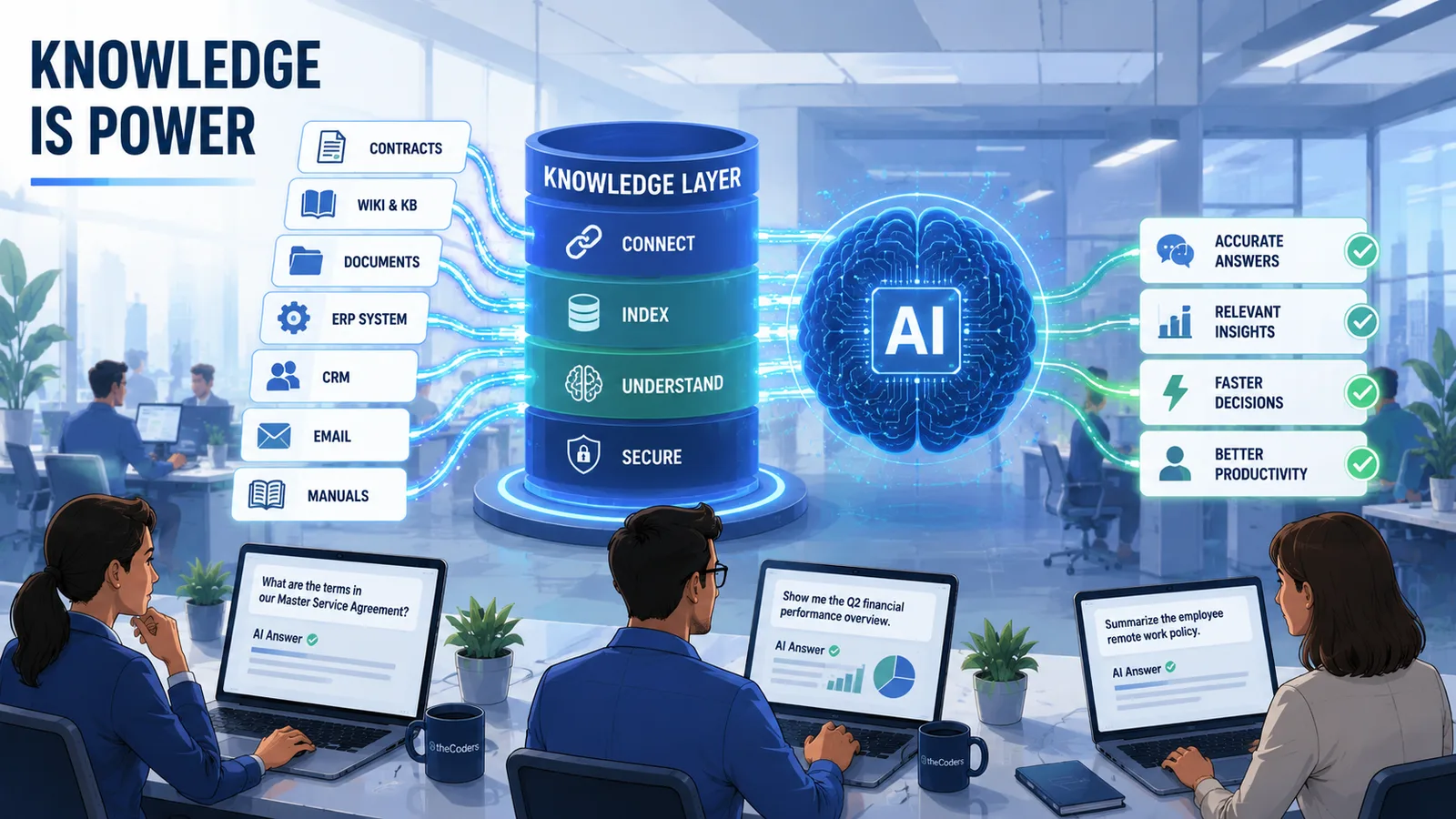
For many companies, knowledge is spread across dozens of disconnected systems: SharePoint, ERP platforms, CRM systems, internal Wikis, network drives, PDF manuals, email archives, knowledge bases, cloud storage, business applications. Each contains valuable information. Very few are connected.
Without organization, even the most advanced AI model struggles to provide reliable answers. That’s why every successful AI implementation requires a structured Knowledge Layer. This layer connects the organization’s information sources, applies access controls, indexes content, and makes relevant knowledge available to the AI when needed.
Instead of responding with generic information learned during training, the AI begins answering using the company’s own documentation, policies, procedures, and operational knowledge. The result is dramatically different. Employees stop searching through folders and documents. They simply ask a question. The AI finds the relevant information, understands the context, and provides an answer grounded in the organization’s own knowledge.
AI should do more than answer questions
For many people, artificial intelligence is still synonymous with a chatbot. In reality, conversation is only one small part of what modern AI systems can do. A properly designed AI infrastructure doesn’t simply answer questions. It performs work.
It reviews documents as they arrive. It classifies information. It extracts key data. It generates reports. It validates business rules. It prepares commercial proposals. It assists customer support teams. It routes requests to the appropriate department. It automates repetitive administrative tasks.
These capabilities are made possible through AI Agents. Unlike traditional chat interfaces, AI Agents operate as autonomous components within business workflows. They receive information, make decisions based on predefined rules, interact with existing systems, and complete repetitive tasks with minimal human intervention.
Instead of becoming another application employees have to use, AI becomes part of the organization’s operational infrastructure. At that point, artificial intelligence is no longer just a productivity tool. It becomes part of how the business operates every day.
Every organization needs a different AI architecture
No two companies operate in exactly the same way. Some require fully on-premises infrastructure. Others benefit from private cloud environments. Some organizations rely entirely on open-source language models. Others achieve better results through hybrid architectures that combine private models with carefully selected cloud services.
There is no universal blueprint. And that’s precisely why we don’t deliver standardized AI implementations. We design architectures that reflect each organization’s business goals, security requirements, technical maturity, and operational processes.
For one company, the right solution may be a single internal AI assistant. For another, it may be an ecosystem of specialized AI Agents integrated with ERP systems, CRM platforms, document management systems, and internal business applications.
Technology is never the starting point. Business architecture is. Because the long-term success of an AI initiative isn’t determined by the language model you deploy. It’s determined by how well that technology fits the way your organization works.
Key takeaway: companies don’t need another chatbot. They need an AI architecture designed around their people, processes, data, and business objectives. Private AI is simply one component of that architecture — not the destination itself.
How we design AI infrastructure
Over the past few years, we’ve seen the same pattern in almost every digital transformation project. Companies rarely lack technology. What they lack is the right architecture.
That’s why we never begin with the question “Which AI model should we deploy?” We begin with a far more important one: “What business problem are we trying to solve?” That single question changes the entire direction of a project. Instead of focusing on technology first, we focus on business outcomes. Only then do we design the infrastructure that supports them.
Phase 1. Discovery & business consulting
Every successful AI project starts by understanding the organization. We work with leadership teams. We analyze business processes. We map workflows across departments. We identify repetitive tasks. We uncover operational bottlenecks. We study how knowledge flows through the company.
This phase isn’t about artificial intelligence. It’s about understanding how the business operates today — and where AI can create measurable value tomorrow. In many cases, the outcome surprises even senior management. Processes considered strategic often provide little opportunity for automation. Meanwhile, seemingly simple administrative activities may consume hundreds of working hours every month.
That’s why discovery isn’t simply the first step. It’s the stage that defines the success of every stage that follows.
Phase 2. Designing the architecture
Once the business requirements are clear, we design the technical architecture. Every organization has different requirements. Some need a fully on-premises deployment. Others prefer a private cloud. Many benefit from a hybrid architecture that combines local infrastructure with selected cloud services.
At this stage we also evaluate the technologies that best fit the project. Open-source models such as Llama, Qwen, Mistral, or DeepSeek may be the right choice. In other situations, commercial enterprise models or hybrid deployments provide greater value.
Technology is never selected because it’s popular. It’s selected because it supports the organization’s long-term goals.
Phase 3. Building the Knowledge Layer
Artificial intelligence becomes valuable only when it understands the organization’s knowledge. That’s why one of the most important stages of every implementation is building a structured Knowledge Layer. This connects the AI to the company’s information ecosystem, including:
- contracts;
- internal procedures;
- technical documentation;
- ERP systems;
- CRM platforms;
- SharePoint;
- knowledge bases;
- internal Wikis;
- business documents;
- operational manuals.
Instead of relying on generic knowledge from the public internet, the AI retrieves information directly from trusted internal sources. Employees receive answers that reflect how their organization operates — not how an average company operates.
Phase 4. Intelligent process automation
Once knowledge is connected, AI can begin participating in business operations. This is where conversational AI evolves into operational AI. We design AI Agents capable of supporting repetitive business activities, including:
- document analysis;
- information extraction;
- report generation;
- contract preparation;
- customer support assistance;
- workflow automation;
- compliance verification;
- internal process orchestration.
Rather than replacing employees, these agents remove repetitive work and allow people to focus on activities that require expertise, creativity, and decision-making.
Phase 5. Governance, security & compliance
AI infrastructure must follow the same security principles as every other enterprise system. That means clearly defined permissions, role-based access, audit trails, monitoring, usage policies, logging, and compliance controls.
Organizations need complete visibility into how AI is being used, which information it accesses, and how data is protected throughout every interaction. Security isn’t an optional feature. It’s part of the architecture from day one.
Phase 6. Continuous evolution
Artificial intelligence evolves rapidly. Businesses evolve even faster. New processes emerge. New opportunities appear. Departments change. Data grows.
That’s why we don’t see AI implementation as a one-time deployment. We see it as a long-term capability. After launch, we continue refining the architecture, improving performance, integrating additional business processes, and identifying new opportunities where AI can create value. For us, deployment is never the finish line. It’s the beginning of continuous improvement.
Why companies choose theCoders
Technology can be purchased. Infrastructure can be deployed. Language models can be replaced. Experience cannot.
The strength of theCoders lies in the people behind every project. Before joining theCoders, members of our team designed and built enterprise software, cloud infrastructure, distributed systems, and mission-critical platforms for some of Europe’s largest companies and organizations.
That experience shapes the way we approach every AI project. We don’t see AI as another application. We see it as part of a company’s long-term digital infrastructure. Every recommendation is based on business requirements — not technology trends. Every architecture is designed around the organization — not around a predefined product.
Our objective isn’t simply to deploy artificial intelligence. It’s to build systems that continue creating measurable business value long after implementation is complete.
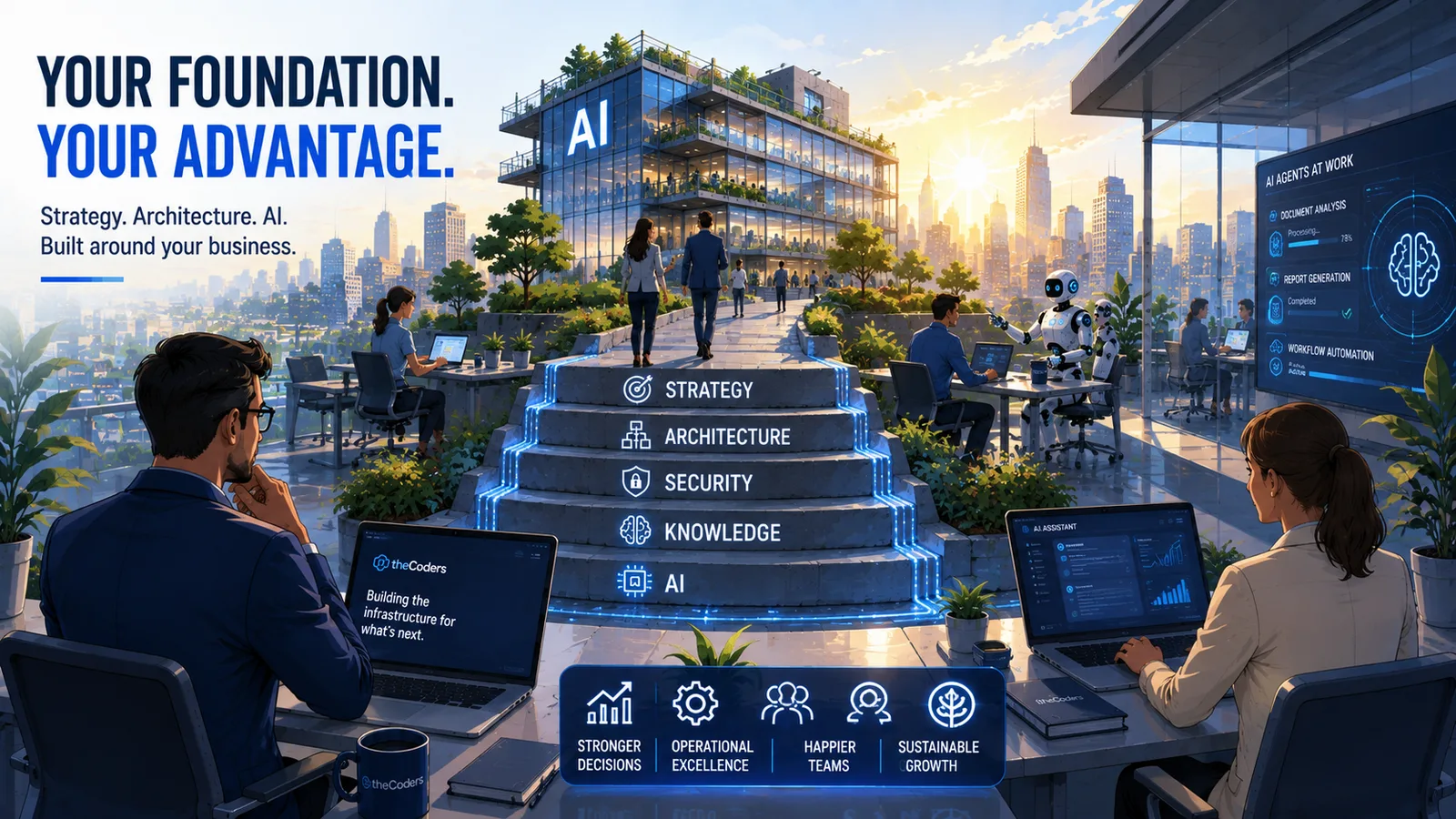
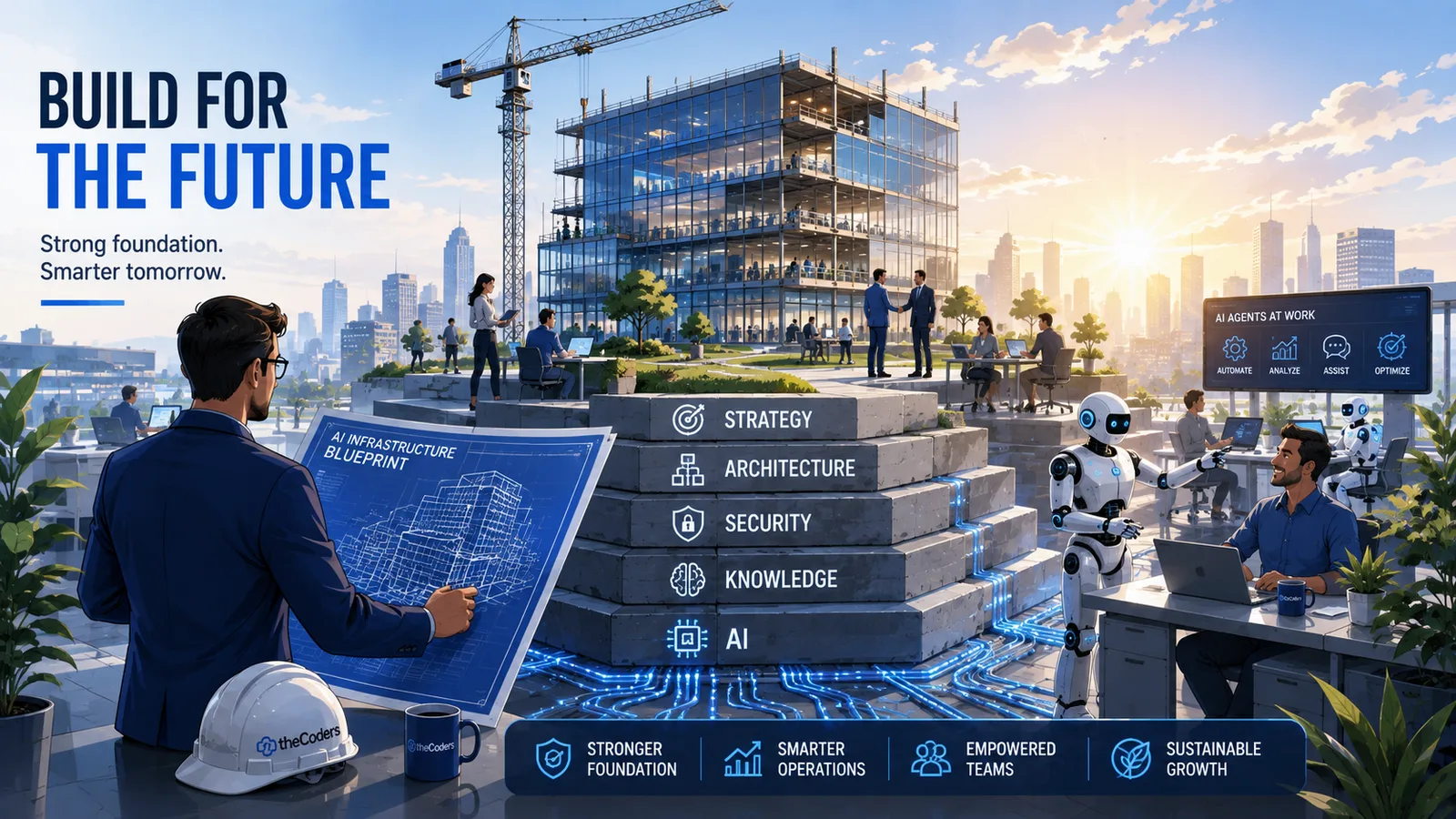
The future of enterprise AI isn’t about models. It’s about strategy.
Over the next decade, artificial intelligence will become part of nearly every business. Not because it’s a trend, but because it will become another layer of enterprise infrastructure — just like cloud computing, cybersecurity, or ERP systems before it.
The question is no longer whether organizations will use AI. Most already do. The real question is whether they will use it strategically.
Some companies will continue relying entirely on public AI services. For many businesses, that may be the right decision. Others will decide that controlling their own infrastructure, protecting sensitive information, and integrating AI directly into their business processes creates greater long-term value. Neither approach is universally correct. Every organization has different objectives, different constraints, and different levels of technical maturity.
That’s precisely why AI should never begin with technology. It should begin with business — with understanding how people work, how information moves, where decisions are made, where time is lost, and where artificial intelligence can create measurable improvements. Only after those questions are answered does technology become relevant.
Language models will continue evolving. New vendors will emerge. Today’s leading models will eventually be replaced. But well-designed business processes and a strong AI architecture will continue delivering value regardless of which model powers the system.
At theCoders, that’s how we approach every project. We don’t begin by recommending a model. We begin by understanding the organization, design the architecture, build around business objectives, and only then select the technologies that best support those goals. Because successful AI projects aren’t defined by the models they use. They’re defined by the business outcomes they create.
Ready to explore what AI could do for your business?
Every organization is different. That’s why every successful AI implementation begins with a conversation — not with software. If you’re evaluating how artificial intelligence could improve your operations, automate repetitive work, or help your teams make better use of internal knowledge, we’d be happy to help you assess the opportunities. Whether the right solution is a private AI platform, a hybrid architecture, or simply a better roadmap, the first step is understanding your business — not choosing a language model.