Why Most AI Projects Fail (And How to Do AI Right)
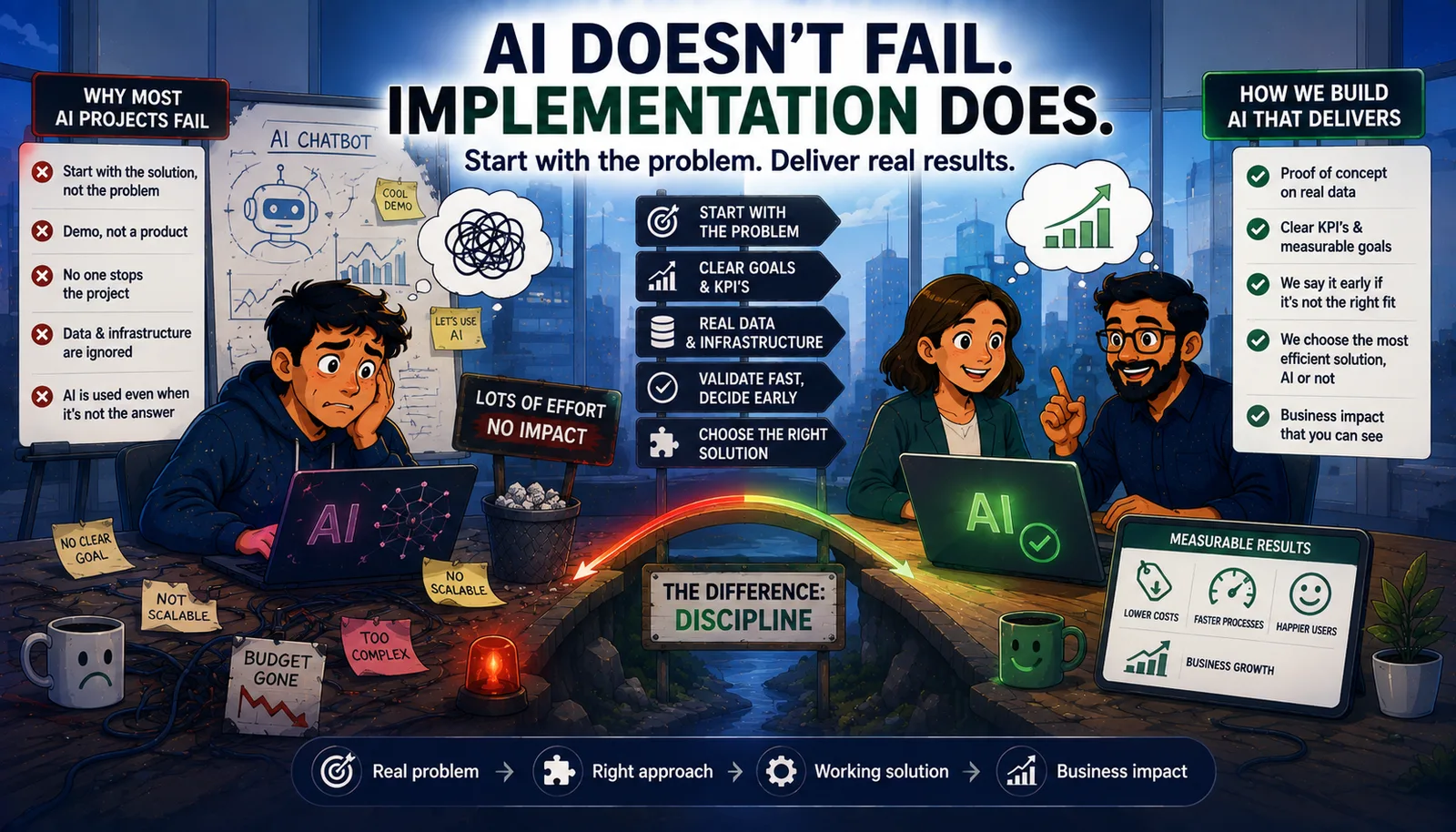
Implementing artificial intelligence has become a top priority for businesses. Yet many AI projects never deliver measurable business value. The problem is rarely the technology itself — it is the way companies approach the implementation.
Over the past few years, numerous industry reports have shown that a large share of enterprise AI initiatives fail to meet expectations. From our experience at theCoders, the reason is almost always the same: organizations start with the technology instead of the business problem.
Why AI projects fail
1. They start with the solution instead of the problem
“We want AI in our product” is not a strategy. The real question is: what process becomes faster, cheaper, or more effective? Without clear business goals and measurable outcomes, success cannot be evaluated.
2. A demo is not a product
Building an impressive demo is easier than ever. Building a reliable product that works across thousands of real-world scenarios, messy data and edge cases is where most projects stop.
3. Nobody wants to stop the project
After a company announces an ambitious AI initiative, admitting that a pilot failed becomes politically difficult. As a result, projects keep consuming time and budget without delivering real value.
4. Data and infrastructure are ignored
In most AI initiatives the real work is integrating systems, cleaning data and improving business processes. AI is usually the final layer — not the foundation.
When AI is not the right answer
Not every business challenge requires artificial intelligence. In many cases, process automation or well-designed business rules deliver faster, cheaper and more maintainable solutions. Successful AI adoption begins by validating whether AI is actually necessary.
How we approach AI projects
- Start with a proof of concept using real business data.
- Define measurable KPIs before development begins.
- Be transparent when the assumptions turn out to be wrong.
- Choose the best solution — even when it does not involve AI.
A real example
A client asked for an AI-powered customer support chatbot. After analysing their workflow, we found that most requests could be solved through knowledge-base improvements and simple automation. The result was lower costs, a faster implementation and a better customer experience.
Conclusion
Artificial intelligence can transform a business — but only when it solves a real problem. The difference between an impressive demo and a successful AI project is discipline: clear objectives, quality data, fast validation and measured outcomes.
At theCoders we build software and AI solutions that deliver business value, not just impressive presentations.