How to Build a Successful App as an Entrepreneur: Idea to Launch
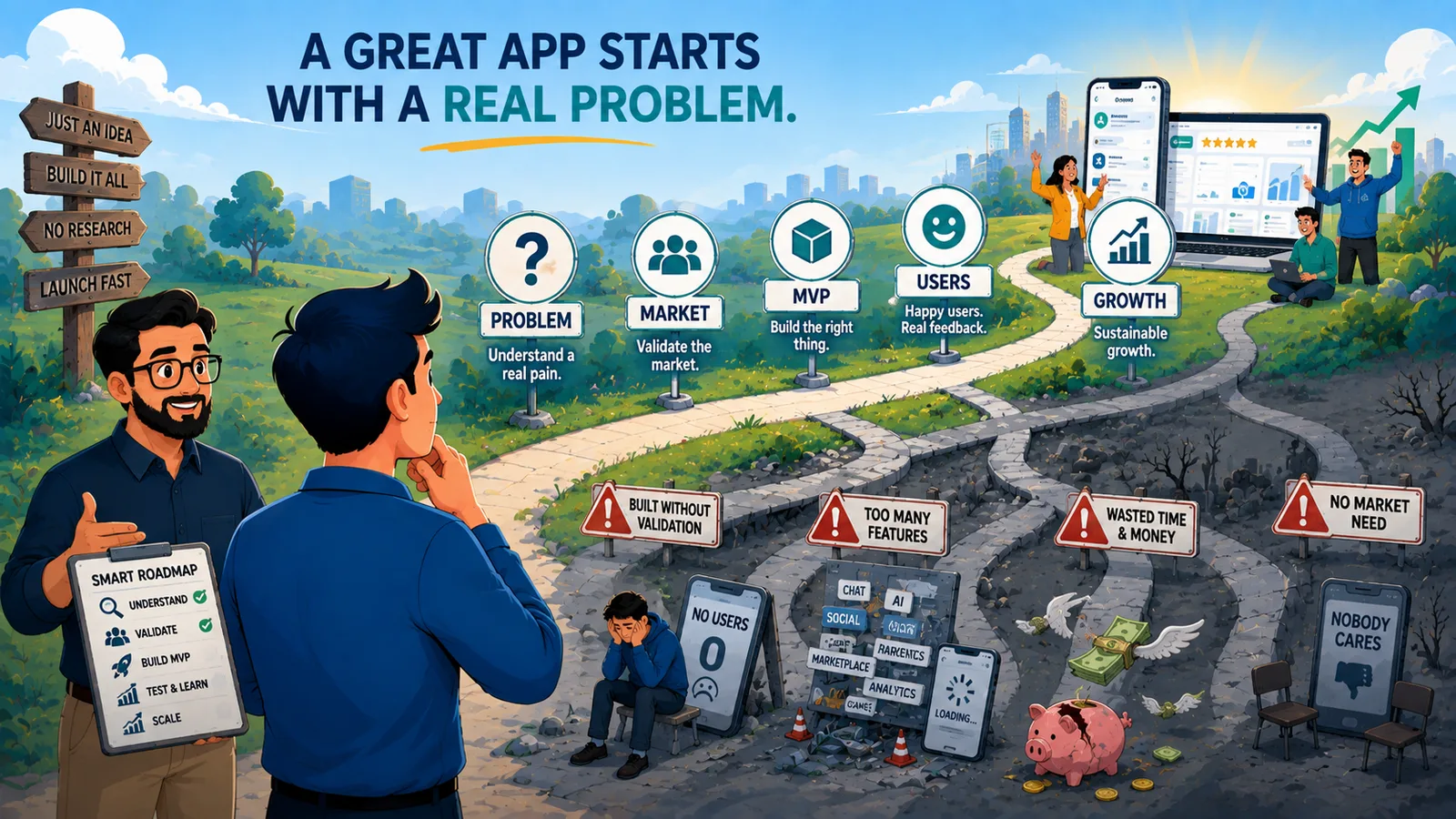
Every day, thousands of new app ideas are born. Only a small percentage become products people actually use, and even fewer grow into profitable businesses.
Surprisingly, most applications don’t fail because of poor technology. They fail because they solve problems people don’t actually have — or aren’t willing to pay to solve. According to research by CB Insights into why startups fail, one of the most common causes is the lack of product-market fit: the product simply doesn’t meet a real need in a market willing to adopt and pay for it.
Before investing thousands of euros in development, it’s worth taking a step back and validating both the idea and the opportunity. Here’s how.
1. Start with the problem, not the idea
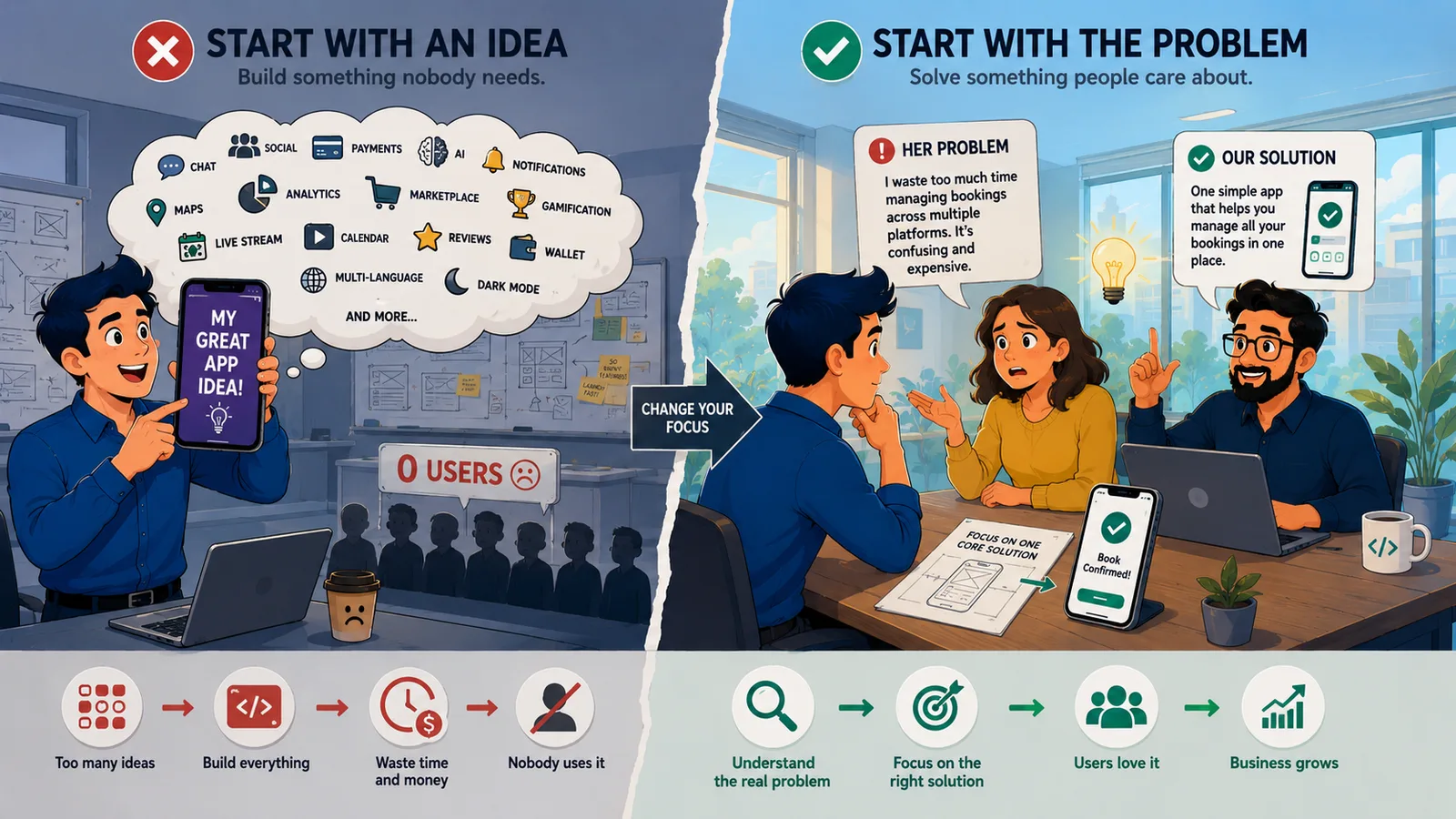
One of the most common mistakes entrepreneurs make is falling in love with an idea instead of understanding a problem. Successful companies don’t begin by asking “What app should we build?” — they ask “What problem can we solve better than anyone else?”
Ask yourself:
- What problem does my product solve?
- Who experiences this problem?
- How often does it occur?
- How expensive or frustrating is it?
- Would someone actually pay for a better solution?
The more painful, frequent and costly the problem, the greater your chances of building a successful business. Uber didn’t invent transportation, Airbnb didn’t invent accommodation, and Slack didn’t invent communication — they simply solved existing problems in a significantly better way.
2. Validate the market before writing code
One of the most expensive mistakes is building software before validating demand. Before development begins:
- Interview at least 20–50 potential customers
- Observe how they currently solve the problem
- Identify their frustrations
- Analyze the solutions they already use
- Test whether they’re willing to pay
If nobody is willing to pay for your solution, the problem isn’t your application — it’s the idea itself. Market validation is far less expensive than rebuilding an unsuccessful product.
3. Research your competition
Many founders proudly say “we have no competitors.” In reality, almost every product has competition — and it isn’t always another app. It might be a spreadsheet, email, WhatsApp, an internal process, or simply an employee doing the task manually.
Study your competitors carefully and understand what they do well, what customers dislike in their reviews, which features are missing, and how they make money. The best opportunities rarely exist in empty markets. They exist where demand already exists but users remain dissatisfied.
4. Build an MVP first
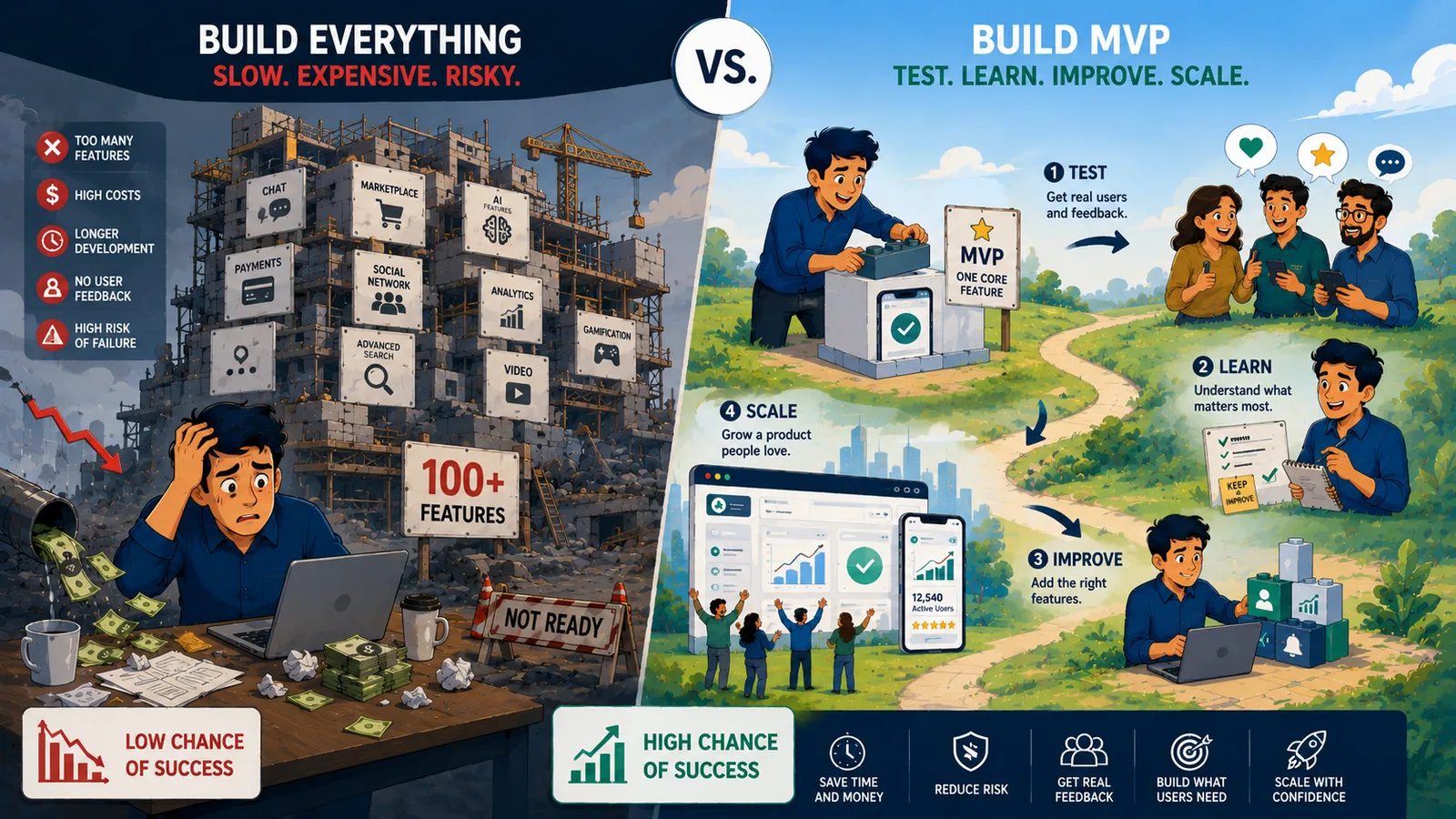
One of the biggest startup mistakes is trying to build everything at once. You don’t need 100 features — you need one feature that solves one important problem exceptionally well. This is called a Minimum Viable Product (MVP). As a rough guide, an MVP costs between €2,000 and €9,000 — see our pricing guide.
The purpose of an MVP isn’t perfection. Its purpose is to answer one critical question: will people actually use and pay for this product? Once you collect feedback from real users, the product can evolve naturally. This is how many of today’s most successful startups began.
5. Choose the right team
Great software is built by great teams — not individual developers. Depending on the project’s complexity, your team may include:
- Product Manager
- Business Analyst
- UX Designer
- UI Designer
- Software Architect
- Frontend Engineer
- Backend Engineer
- Mobile Developer
- QA Engineer
- DevOps Engineer
Each role contributes to the final quality of the product. Outstanding code cannot compensate for poor user experience — and, likewise, beautiful design cannot save unstable software.
6. UX and UI can determine success or failure
Many entrepreneurs confuse UX with UI. UI (User Interface) focuses on appearance; UX (User Experience) focuses on how people actually interact with the product. A beautiful application can still be frustrating to use, while a simple one with excellent UX can attract millions of users.
Always ask yourself:
- How many clicks does a task require?
- Is navigation intuitive?
- Can users understand the interface immediately?
- Are unnecessary steps slowing people down?
Every second saved and every unnecessary click removed can improve satisfaction, conversion and retention.
7. Performance matters
Users don’t compare your application with other startups. They compare it with Google, Spotify, Netflix, Revolut and Instagram — the products they use every day. Your application should be fast, secure, reliable, scalable and easy to maintain. A strong software architecture lets your business grow without rebuilding everything from scratch.
8. Launch is only the beginning
Many founders believe the project ends when the application goes live. In reality, that’s where the real work begins. The first months should focus on user feedback, bug fixes, analytics, conversion optimization, feature improvements and product iteration. Successful products evolve continuously.
9. Marketing starts before development ends
One of the biggest mistakes is finishing the product first and looking for customers later. Marketing should begin long before launch. Build an email waiting list, a community, educational content, landing pages, product demos, early-access programs and case studies. A successful launch happens when people are already waiting for your product.
10. Measure everything
Don’t rely on assumptions — rely on data. Track metrics such as:
- Monthly Active Users (MAU)
- Retention rate
- Session duration
- Conversion rate
- Customer Acquisition Cost (CAC)
- Customer Lifetime Value (LTV)
- Churn rate
- User feedback
The best products improve because they continuously learn from their users.
Technology alone doesn’t build great products
Entrepreneurs often spend months debating whether to use React, Flutter, .NET or Node.js. But customers don’t buy technology — they buy solutions. The best stack is the one that enables rapid development, long-term scalability, security and maintainability. Technology should always support business goals, not replace them.
How we build digital products at The Coders
At theCoders, we believe successful software starts with understanding the business — not writing code. Before development begins, we analyze the problem you’re solving, your target audience, market demand, the competitor landscape, your monetization strategy, the user experience, the technical architecture and your scalability requirements.
Only after this discovery phase do we begin development. Our objective isn’t simply to deliver working software — it’s to build digital products designed to grow alongside your business and its users.
Final thoughts
Successful applications are rarely built by accident. They begin with a real problem, validated demand, thoughtful planning and continuous improvement. Technology is only the tool that transforms an idea into a product.
The difference between an app that disappears after six months and one that becomes a sustainable business usually lies in research, execution, user feedback and long-term iteration. If you’re planning to build a digital product, invest as much time understanding your customers as you do building your software — that investment almost always produces the highest return.
Sources & research
The principles in this article are informed by research and publications from internationally recognized organizations, including:
- CB Insights — The Top Reasons Startups Fail (research on product-market fit)
- Y Combinator — startup advice and product-market-fit methodology
- First Round Capital — startup growth and product-development research
- Harvard Business Review — innovation and product-strategy publications
- Nielsen Norman Group (NN/g) — UX research and usability best practices
- Google Search Central — official guidance on website quality, performance and user experience
Because technology, user behavior and digital markets evolve continuously, successful products require continuous learning, testing and improvement — not just great code.